Sunday, 1 October 2023

SAMJNAANAM - UNDERSTANDING


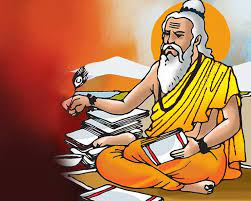
Veda is a word applied to a particular section of Sanskrit literature that forms the earliest record of the world in general and of India in particular

This literature is divided into two portions namely Mantra(Hymns) and Braahmanams (Explanatory Works).  Again the Mantra portion is subdivided into four parts or groups based on the four types Vedic texts namely RigVeda, YajurVeda, SaamaVeda and AtharvaVeda.

SAMJNAANAM (RigVeda : X - 191) 

This is the name of the particular hymn consists of only four verses.  Here the Vedic Sage stresses on the units of Mind, Speech and Action.

The first verse is addressed to Fire-God (Agni) and the rest are addressed to the worshippers(Sthothaaras).

SAMSAMIDHYUVASE VRUSHANNAGNE VISVAANYARYA AA  I

ILASPADHE SAMIDHYASE SA NO VASOONYAA BHARA  II 1 II

"O! Agni, the fulfiller of desires, as a lord you unite all on all sides.  You are kindled at the altar of earth.  you such bring opulence on all sides".

SANGACHCHADHVAM SAMVADHADHVAM SAM VO MANAAMSI JAANATHAAM  I

DHEVAA BHAAGAM YATHAA POORVE SANJAANAANAA UPAASATHE  II 2  II

"Go together, speak together, let your minds be of one concord.  As the ancient gods with one accord accept their sacrificial share, so also you too accept your share of life with one accord".

The sage's caution is not to be envious at other's profits or losses; but share their life with a single mind, speech and action.

SAMAANO MANTHRAS SAMITHAS SAMAANEE 

SAMAANAM MANAS SAHA CHITHTHAMESHAM  I

SAMAANAM MANTHRAMABHI MANTHRAYE VAS 

SAMAANENA VO HAVISHAA JUHOMI II 3 II

"Let their thought or planning be the same; their gain be the same; their mind be the same; their heart be united; I also the same with you and I offer with your same oblation or sacrifice".

Generally, Vedic texts have a two-fold purpose.  One is to propitiate the deities, and the second at the same time is to carry an inner or hidden secular message, to the society.  So the other aspect of a Vedic verse is always to be kept in mind.

SAMAANEE VA AAKOOTHIS SAMAANAA HRUDHAYAANI VAHA  I

SAMAANAMASTHU VO MANO YATHAA VAS SUSAHAASATHI  II  4  II

"Be your intention the same, your hearts the same, your mind the same; that it may be a good company for you".

Here the Vedic Sage advises the people to keep their mind, speech and action united, so that they become a united society, which definitely proves to be a good company for one and all.  


Sunday, 24 September 2023

MY PLANS FOR LAST QUARTER OF 2023


I am eagerly planning  to complete my Sanskrit research project titled "VASAVADATTAA - A Critical Study" in the last quarter of 2023.  

Vasavadatta (वासवदत्ता, Vāsavadattā) is a Classical Sanskrit romantic tale (akhyayika) written in an ornate style by Subandhu, whose time period isn't precisely known. He is generally taken to have written the work in the second quarter of the seventh century. However, many scholars have stated that he was a courtier of the Guptha Emperors KumaaraGuptha I (414-455) and SkandhaGuptha (455-467), dating him between 385 and 465 AD.  The work's style has been described as "developed, elaborate, ornate and pedantic" and has influenced later prose writers.

I have a specific timeline and goal in mind for my research work. Here I share my plans:

Research projects can vary widely in scope and can be related to various fields such as science, technology, social sciences, humanities, or business.  Mine is based on humanities.

The goal is to finish or complete my research project. During this period, I will be actively conducting my research. This may involve various activities such as data collection, literature reviews, surveys or analysis, depending on the nature of my research and documentation finalized by the end of the last quarter of 2023.  I am planning to conclude my research work during these three months.

To achieve this goal successfully, I need to plan and prepare carefully. This involves setting clear objectives, creating a research plan or timeline, allocating resources, and identifying any potential challenges that may arise.

As I progress with my research, it's crucial to document my findings, methods, and insights. This documentation will be the foundation of my research project's final form.

After collecting data I need to analyze the results and synthesize my findings. This is a critical step in drawing conclusions and contributing new knowledge to the field.

Once I have analyzed my data and drawn conclusions, I need to write a research paper, thesis, or report. I may also prepare a presentation to communicate my findings to instructors.

After completing the initial draft, it's common to go through several rounds of review and revision to ensure the quality and accuracy of my work.

As my research project is part of an academic program, I need to submit my work according to the institution's guidelines.

Completing a research project is a significant undertaking, and it's essential to stay organized, manage time effectively, and seek guidance and feedback from mentors.

 I look forward to successful completion of my research project.


(This blogpost is a part of Blogchatter's Bloghop (Weekly prompts 19 Sep to 25 Sep))

Monday, 18 September 2023

SCIENTIFIC LITERATURE IN SANSKRIT PART VI


Continuation of Part V (Sunday 2, July 2023)

KAATHYAAYANA

Kaathyaayana also known as Vararuchi wrote the Vaarthika to the Suthras of Paanini in which he has corrected, modified and supplemented some of the Suthras (Ukthanukthadhurukthavicharo Vaarthikam).  This was probably due to the changes that occured in the spoken language in the course of more than 200 years after Paanini.  Katyaayana is placed somewhere in 5th century B.C.

When the language treated by Paanini stands closest to that of the Vedic portions like Brahmanas, Upanishads and Kalpasuthras, first Kaathyaayana later Pathanjali, the successors of Paanini, had essentially in view the language of Classical Sanskrit Literature.

Though MahaaBhaashyam is the commentary on Paanini's Ashtaadhyaayee, it will be more accurate if we say that Pathanjali speaks more about Kaathyaayana than about Paanini.  The Vaarthikaas too do not constitute a commentary on Paanini, but they are really critical, explanatory and complimentary notes on certain rules.

Kaathyaana is not, as many people believe, an opponent of Paanini, rather his admirer and follower.  Kaathyaayana examines without sparing pains the rules of the teacher and objections raised against them, and either sets aside these objections or improves upon the rules.  And in only few cases, Kaathyaayana has rejected the suthras of Paanini.

Frequently the Vaarthikaas constitute the supplements, that partly rest upon the actual shortcomings of Paanini's teachings and are partly based on the fact that the linguistic usage had very much changed during the interval that elapsed between Paanini and Kaathyaayana.  Thesse Vaarthikaas are generally short prose sentences written in the style of Suthras, but they are not so brief as the suthras of Paanini.  There are also a metrical Vaarthikaas (Sloka-Vaarthikaas) that are based only in part on Kaathyaayana himself and in parts of other predecessors of Pathajali.


Wednesday, 6 September 2023

FAMOUS FOUR SANAKADIS


Sanaka, Sanandhana, Sanaathana and Sanathkumaara are called collectively Sanakadis in general.  They were the mind-born children (sons) of the Creator Brahma.  Bhavishyad Puraanam mentions that the Sanakadis were the incarnations of portions of Mahavishnu.  Once Brahma praised these Sanakadis the incarnations of Mahavishnu.  


These Sanakadis had taken incarnation before the Creator Brahma began the work of creation. So they stood in the form of infants, they were asked to create subjects.  But they were the incarnation of "Satthva" (the attribute of purity), and also they were not prepared to undertake creation.


Even at the early age of four, these four learned the Vedas (ChathurVedas) with their auxilliaries (Shadangas), and travelled together.  They were celebrated for ever by all around the fourteen worlds and they were always called as Kumaaras (Young Boys).  


Bhagavatha Puraanam tells that when the Sanakadis were travelling thus, one day they reached Vaikuntam the divine abode of Lord Mahavishnu, the two door-keepers Jaya and Vijay showed disrespect towards them.  Then these enraged Sanakadis cursed them to have three births with demoniac qualities.   Accordingly, first time, Jaya and Vijaya were born in the earth as Hiranyaksha and Hiranyakasipu who were killed by Mahavishnu who took incarnations namely Varaha and Narasimha respectively.  


In the second birth, they were Ravana and Kumbhakarna  who were killed by Sri Rama the incarnation of Mahavishnu.  In the third birth they were Sisupaala and Dhanthavakthra who were killed By Sri Krishna the incarnation of Mahavishnu.


(This blogpost is a part of Blogchatter's Half Marathon 2023)

Tuesday, 5 September 2023

THIRUJNAANA SAMBANDHAR


There were 63 Naayanmaars who were also called saivite saints originated in Tamil Nadu.  Thirujnaana Sambandhar was the only one youngest  among them. In the town Seerkaazhi the part of Chola's reign of Tamil Nadu, Thirujnaana Sambandhar was born about 7th century AD on the auspicious day in the Tamil month of Chitthirai in Thiruvadhirai star.  His father was Sivapaadha Hrudhayar and His mother was Bhagavathi Ammaiyar.   

When he was 3 years old, his parents took him to the temple of Lord Siva, left him in a  place and gone to get prasadam.  When they get delayed, Thirujnaana Sambandhar started to weep.  At this juncture, Goddess Parvathi appeared before him, and fed him divine milk of wisdom with a golden cup.  

Then, intaking that divine milk, immediately he started to sing in Tamil Language that          

"Thodudaiya Cheviyan Vidaiyeri yor Ven madhi soodi;                                                                          

  Kaadudaiya sudalaippodip poosi yen ullam kavar kalvan;                                                                   

  Edudaiya malaraan munai naatpanindhetthavarul cheydha;                                                            

  Peedudaiya Biramaapurameviya Pemmaan Ivanandre." 

When he was 5 years old, after under going the "Sacred thread ceremony," he started his pilgrimage to almost all the saivaite temples, to worship and sing in praise of Lord Siva and Goddess Parvathi.  

He and his aged friend named Thirunaavukku Arasar alias Appar met in the town by name Vedhaaranyam alias Thiru Maraik Kaadu, where the doors of the shrine of Lord Siva was kept locked for a long time.  Appar made it to open by singing ten padhigams (divine lyrics) and Sambandhar  closed it by singing other ten padhigams.

Having known that the Saivite king of Madhurai adopted  Jainism, by which his subjects also forced to follow the same, he went there and changed him again  into a Saivite by singing ten padhigams about the greatness of divine Ash-powder that "Mandhiramaavadhu neeru etc.,"  Before going there, he sang  for   Appar's recovery the ten padhigams called KOLARU PADHIGAM starts with "Veyuru tholi pangan etc.,"

Once, in Mylapore in Chennai, the young girl by name Poompaavai the daughter of Saivite trader Sivanesa, was became dead due to the snake-bite.  Then Sivanesa lamented along with his wife and highly grief-sticken, after their daughter was cremated.  When Sambandhar visited there, Sivanesa narrated all the matter to him.

Then, Sambandhar asked them to get bones and ashes of that dead-girl. He revived her by singing the padhigams by holding the bones.

Once, Sambandhar turned the 16, his parents forced him to get married. He refused to do so and  sang the ten padhigams called Namas Sivaaya Panchaakshara Padhigam starts with "Kaadhalaagik kasindhu Kanneer malgi etc.," and attained  the divine feet of Lord Siva. 


(This blogpost is a part of Blogchatter's Half Marathon 2023)

Monday, 4 September 2023

KUSA


Kusa was a son of Sri Rama and Sita.  When Sita was forsaken by Rama in the forest, Valmiki has given the refuge to Sita.  She was pregnant on that time.  Lava was born in the asramam of Valmiki.

Once Valmiki who didn't know that Sita took Lava to the stream to bathe him, when he returned the asramam. He became upset not to see the child Lava there.  He feared that it might have been eaten up by some animal, and fearing that Sita might die when she missed the child.  Valmiki created a child with Kusa grass and laid him where Lava was laying before.

When Sita returned to the asramam with Lava after their bath, Valmiki explained the whole situation to Sita.  Since the second child was created with Kusa grass, he was made the second son of Sita and named meaningfully KUSA.

Kusa gained his education along with Lava from the Sage Valmiki.  Both of them became very intelligent got the mastry in the archery even in their young age.  They learnt the secrets about divine arrows. 

One day Kusa with Lava, captured the sacrificial horse of Asvamedha Yajna of Sri Rama, which was followed by Satrughna.  Satrughna could not defeat Kusa and Lava even with the help of Lakshmana.  Then Valmiki intervened and the sacrificial horse was returned to Satrughna.

Once, Kusa along with Lava visited the city Ayodhya, entered the court and started to recite the Ramayanam written by Valmiki in front of Sri Rama.  Then Sri Rama came to know about them as His sons and made them both to live in his palace.

(This blogpost is a part of Blogchatter's Half Marathon 2023)

Sunday, 3 September 2023

LAVA


Lava was a son of Sri Rama and Sita.  When Sita was forsaken by Rama in the forest, Valmiki has given the refuge to Sita.  She was pregnant on that time.  Lava was born along with Kusa in the ashram of Valmiki.

Lava gained his education along with Kusa from the Sage Valmiki.  Both of them became very intelligent got the mastery in the archery even in their young age.  They learnt the secrets about divine arrows. 

Once, being instructed by Valmiki, Lava went to the mount Kailasa  and after killing many Yakshas, collected the golden lotus flowers from Kubera's pond and other flowers of Kalpakavruksha from Kubera's garden, to worship Sivalinga.

One day Lava with Kusa, captured the sacrificial horse of Asvamedha Yajna of Sri Rama, which was followed by Satrughna.  Satrughna could not defeat Lava even with the help of Lakshmana.  Then Valmiki intervened and the horse was returned to Satrughna.

After some time, Lava along with Kusa visited The city Ayodhya, and recited the Ramayanam written by Valmiki in front of Sri Rama. 

Rama recognized Lava with Kusa and made them both to live in his palace.

(This blogpost is a part of Blogchatter's Half Marathon 2023)

VĀMANA BHAṬṬA BĀṆA: LIFE AND SANSKRIT WORKS

  Vāmana Bha ṭṭ a Bā ṇ a ( वामनभट्टबाण) was a Sanskrit poet, dramatist, and prose writer associated with the later classical period of Sans...