Sunday, 13 February 2022

28 MORAL FABLES FROM SANSKRIT LITERATURE-TALE 13


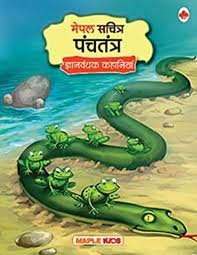
The Story of a wise snake

Closer to a certain part of the Varuna mountain, there lived an aged black Cobra by name MandhaVisha.  He deliberated in his mind thus:  How can I manage to have a comfortable living.  He then crawled towards a great assemblage of frogs and gave an impression that he was infirm. 

As he stayed thus, one of the frogs swimming near the edge of the water-pool asked him thus:  Hi! Uncle! How come you are not hunting for food as before? MandhaVisha replied thus: My dear! How can an unfortunate like me, desire for food?  Today in the early hours of the night, I was crawling around looking for food and I noticed a frog and prepared to grab him too.  He too noticed me, and in the fear of death slipped in somewhere in the group of students who were intent on reciting texts and could not make out which way the frog had slithered away.  But at the edge of the pool, a student was standing and I mistaking his toe for a frog, bit it hard.  The boy too instantly died.  His father, stung by grief, cursed me thus: you wicked! You strung my innocent son to death.  You shall suffer for this by becoming a vehicle for frogs.  And you shall live entirely on what the frogs allow you for food.  So I am here as your vehicle.


Through him the news was carried to all the other frogs.  They were all excited about it that they approached the frog-King JalaPaadha.  He in turn, thinking what a wonderful happening it was, swam out of the pool in a hurry and accompanied by his ministers went and sat on the hood of MandhaVisha.  The other frogs in order to seniority many of them also climbed on to the back of MandhaVisha.  The others not finding space on the back of MandhaVisha, hopped behind him.  MandhaVisha, on his part keen on securing a comfortable living for himself, showed them different kind of turns and movements.


Then, next day, MandhaVisha crawled slowly.  Looking at that, the frog-King JalaPaadha said thus: Oh! Friend! MandhaVisha! Why are you not carrying us nicely as you did before?  MandhaVisha replied thus:  Oh! Lord! Due to the lack of food, I do not have the strength to carry you proper today.  Then the frog-king told thus: Oh! Good fellow! You can feed yourself on common frogs.  On listening this, MandhaVisha thrilled with delight in every part of his limb started to say thus: Oh! The frog-king! I have this curse on me.  But by your word of command, I am delighted. 


Then, MandhaVisha started eating frogs continuously without interruption, so much that in a few days, he grew strong.  Thus all the frogs were eaten by him.


Moral of the story:

“Skandhena api vaheth sathrum kaalam aasaadhya buddhimaan l

  Mahathaa krushna sarpena Mandookaa bahavo hathaah  ll”


Waiting for a proper time to succeed, a wise, should bear even the enemies on his back, like a wise-black Cobra by name MandhaVisha by whom all the frogs were being borne and eaten.

(This story is taken from the titled Kaakolookeeyam - the 3rd volume of the book PanchaThanthram which has five volumes viz., MitraBedhah, MitraLaabhah, Kaakolookeeyam, Labdhapranaasam and AparikshitaKaarakam written by Vishnu Sarma was an Indian scholar.  The exact period of the composition of the Panchatantra is uncertain, and estimates vary from 1200 BCE to 300 CE.

(#WriteAPageADay, today's word count = 521)

This is a part of Blogchatter's write a page a day campaign.

https://www.theblogchatter.com/campaign-registrations/write-a-page-a-day


Saturday, 12 February 2022

28 MORAL FABLES FROM SANSKRIT LITERATURE-TALE 12


The story of Jealousy Monkeys and Birds

There is a large silk-cotton tree on the banks of the river Narmada, in the vicinity of a hill.  There, in the interiors of nests, built by themselves lived certain birds in happiness even in the monsoons.  Once in the rainy season, the sky being overcast with masses of clouds looking like so many dark veils, there fell a heavy shower of rain in large streams.  Then the birds seeing some monkeys at the foot of the tree, suffering, from cold and shivering, said, through mercy-Oh! Monkeys! Please listen-

“Asmaabhir nirmithaa needaas

  chanchu maathraahathais thrunaih  l

  Hastha paadhaadhi samyukthaa

  Yooyam kimithi seedhatha ll”

We have built nests with straws bought by means of nothing else but our bills: why do you, who are endowed with hands and feet, experience suffering?

Hearing this, the monkeys being enraged said to themselves-Oh! The birds! comfortably lodged in the interior of their nests not exposed to the blast, are reproaching us.  Well, let the showers just cease.  Thereafter, when the downpour of rain had stopped, the monkeys climbed up the tree, and smashed all the nests, so that the eggs of the birds fell down.

The moral of the story:

“Vidvaan eva upadheshtavyo na avidhvaamsthu kadhaachana l

  Vaanaraan upadhisya atha sthaana-bhrashtaa yayuh khagaah ll”

A learned man only should be advised and never an illiterate one; for having offered advice to monkey’s, the birds had to go away deprived of their place of abode. 


(This story is taken from the titled Vigraha the 3rd volume of the book Hitopadesa which has four volumes viz., Mitralaabhah, Suhrudbedhah, Vigrahah and Sandhi written by Narayana Pandita who lived in later part of the 14th Century A.D.)


(#WriteAPageADay, today's word count = 247)

This is a part of Blogchatter's write a page a day campaign.

https://www.theblogchatter.com/campaign-registrations/write-a-page-a-day


Friday, 11 February 2022

28 MORAL FABLES FROM SANSKRIT LITERATURE-TALE 11

                    
The story of Stupid Learners

There lived four youngsters in a certain city with thick friendship.  Due to their young age, they though to learn by going abroad.  After some time, all the four of them decided and started to the foreign country by name Kanyakubja for learning.  At the end of twelve years, with their constant concentration in learning, they became scholars.   After having permitted by their preceptor, they started to return their native.  Then, they kept on moving, and reached a junction of two roads. On seeing that they thought thus: By which way shall we move?  At this juncture, through the first road of that junction, a group of people proceeded towards the cemetery ground to burn the dead one.  Meanwhile first among the four youth opened his book and read thus:  “Mahajano yena gatas sa panthaah which means that is path which is trodden by the group of people”.  Hence they started to follow the group of people who moved towards crematorium.   When they doing so, they reached that place and looked at a donkey which was standing there.  On seeing the donkey, the second among the four youngsters, opened his book and read thus:  “Utsave vyasane chaiva dhurbhikshe sathrusankate l

  Raajadhvaare smasaane cha yas thishtathi sa baandhavah ll”

“They are real relative those who stand there for us to support, at the time of celebrations, miseries, draught, crisis due to enemies, government affairs and in the place the crematorium.”  So, this donkey is our relative. By telling so, one among them embraced the donkey with his neck, another one started to cleanse the feet of it.  At that time they watched a camel which came with fast there accidentally.  On seeing the fast moving camel, they asked thus: What is this.  Immediately and third among the four youth opened his book and read thus: “Dharmasya tvarithaa gathih” which means that is Dharma=Righteousness, which is having swiftest movement.  As per this idea, they understood that this is Dharma.  The the fourth among them opened his book and read thus:“Ishtam Dharmena yojayeth” which means, whichever is favourable to us that is to be added with Dharma.  By telling so, those four young men joined the donkey with the neck of the camel.   

On seeing these deeds of those four youth, people laughed at them and told thus: these persons though learnt highly but don’t know the common sense.  Being ridiculed by the people, the four youth felt shamed and moved their native.


Moral of the story:

“Api saasthreshu kusalaah loka-aachaara vivarjithaah l

 Purushaah haasyathaam yaanthi yathaa the moorkha-pandithaah ll”

Persons though naturally erudite scholars, if they bereft of common sense, they will become the characters of mockery like these stupid learners. (454) 


(This story is taken from the titled Aparikshitakarakam- the 5th volume of the book PanchaThanthram which has five volumes viz., Mitra Bedhah, MitraLaabhah, Kaakolookeeyam, Labdhapranaasam and AparikshitaKaarakam written by Vishnu Sarma was an Indian scholar.  The exact period of the composition of the Panchatantra is uncertain, and estimates vary from 1200 BCE to 300 CE.

(#WriteAPageADay, today's word count = 454)

This is a part of Blogchatter's write a page a day campaign.

https://www.theblogchatter.com/campaign-registrations/write-a-page-a-day


Thursday, 10 February 2022

28 MORAL FABLES FROM SANSKRIT LITERATURE-TALE 10


The Story of a Trader's son

In a certain village there was a son of a trader by name Jirnadhana. He thought of going to foreign countries due to the loss of wealth.  Having enjoyed all pleasures according to one’s capacity or affordability in a place or country if one were to live in the same place or country even after the loss of wealth, then  he is indeed the worst of men.

Moreover - If one, who has once gracefully spent his life with pride, now utters pitiable words then he is indeed a wretched man.  

In his house there was a balance along with iron weights earned by his forefathers. Keeping that balance as a deposit in the house of Sreshthi (a person belonging to trading community) he set out for a foreign country. Having roamed about in the foreign country for a long time he came back to his place and spoke to the Sreshti - ‘Oh Sreshtin! Give me that balance which I had kept as a deposit under your custody’. He (Sreshti) said –‘Oh Sir!  your balance is not here. It had been eaten by rats’. Jirnadhana said – ‘If it had been eaten by rats then it is not your fault. The world is like this. Nothing is permanent here. But now I am going to the river for taking bath. You please send your son Dhanadeva with me carrying the materials of bath (carrying the accessories of bath such as fresh garments, a towel, soap etc.) in his hand. He too suspecting that Jirnadhana may accuse him of the theft (of the balance) and also due to the fear of the theft committed by him told his son-‘my dear son! This is your paternal uncle. He is going to the river for taking bath. Hence go with him taking the materials of bath. 

For, nobody does anything for the other merely out of devotion. He does it through fear, avarice or due to some motive (lit.a cause leading to the effect).

Moreover - Where an excessive regard is shown, without there being a cause for it, there a suspicion should be entertained, that would lead to happiness at the end.

Then that son of the trader with his mind full of joy started to go with the visitor taking the materials of bath. That trader, having taken bath in the river, kept the boy in a cave of the river and closed the entry with a very big boulder and returned home quickly. Sreshtin asked the trader-‘where is my son whom you took with you to the river’?  He told him that his son was taken away by an eagle from the bank of the river.  

The Sreshtin said –‘You liar! Can an eagle take away a boy at any point of time? Give me my son back. Otherwise I will inform the government (court). He (the trader) said –‘Just as the boy is taken away by the eagle in the same way the rats have eaten away the balance along with iron weights. Therefore you give me my balance if you have any use of your son.

Thus arguing with each other they went to the court. There the Sreshtin spoke with a loud voice –‘Oh! Judges!  My son has been kidnapped by this thief (rogue). Then the Judges asked the trader to give the son back (to the Sreshtin). The trader said –‘What shall I do?  As I was looking his child (son) was taken away by an Eagle from the bank of the river. Hearing his speech they (the Judges) said -‘You have not spoken the truth. Is an eagle capable of lifting a boy’? He (the trader) said – Oh! Honorable men! Please hear my words. Where the balance and iron weights are eaten by rats there Oh! King! There the eagle shall eat the boy. There is no doubt in this matter. They (the judges) said –‘How is this’? Then the Sreshtin informed the Judges (lit.civilised people) the entire story from the beginning. Then they laughed at both of them and making them understand each other they also made them happy by giving the child and the balance.

Moral of the story:-
"Kruthe prathikruthim kuryaath himsithe prathihimsitham l
  Thathra dhosham na pasyaamas sate saatyam samaachareth ll"

"If any one helps you, please reciprocate. But if any troubles you, react with the same.  There is nothing wrong.  One should show the rogue-ness to the rogues." (Tit for tat)

(This story is taken from the titled Mithrabhedha - the 1st volume of the book PanchaThanthram which has five volumes viz., Mitra Bedhah, MitraLaabhah, Kaakolookeeyam, Labdhapranaasam and AparikshitaKaarakam written by Vishnu Sarma was an Indian scholar.  The exact period of the composition of the Panchatantra is uncertain, and estimates vary from 1200 BCE to 300 CE.

(#WriteAPageADay, today's word count = 741)

This is a part of Blogchatter's write a page a day campaign.

https://www.theblogchatter.com/campaign-registrations/write-a-page-a-day


Wednesday, 9 February 2022

28 MORAL FABLES FROM SANSKRIT LITERATURE-TALE 9


The rabbit that fooled the elephant

In a part of a forest there lived an elephant-king by name Chaturdanta along with its retinues.  Once there came a twelve-year draught by which the water reservoirs like tanks, ponds, swamps and lakes got dry.  Then, all the elephants told the elephant-king thus: Oh! King! Our calves are highly suffered by the thirst.  Some are dead and some are like to die.  Please search out any water reservoir by which we can protect ourselves from the thirst. Then the elephant-king contemplated for a long time and told thus:  There is a pond in a lonely place which is filled by the waters of Paathaala Ganga.  We shall move there.  Then all the retinues of elephants started to march towards the pond, reached by spending five nights.  After having plunged in to the water as per their wish the elephant-king, along with retinues departed to their portion of that jungle as the session of evening twilight started.  Around that pond, the numerous of rabbits were lived within their beautiful burrows.  When the troops of elephant were moving here and there on their departure, they were crushing the heads, necks and legs of the numerous rabbits.  Some of them were dead, some were left alive and some were supposed to die. 

After the departure of the elephants, the rabbits which were left alive with bleeding and broken heads, necks and legs, which were lost their off springs, families and relatives assembled and planned thus:  Oh! Dear all! We have lost our life.  If the present state continues there will be no hope to survive. Please plan for an idea to remove this trouble. Then the hare by name LambaKarna who was summoned by the other rabbits.  LambaKarna came there and understood the state.  He accepted to be a messenger to the troops of elephant.  He promised thus: I will function as a messenger of the Moon-Lord and share your message which is really a lie.

In the very next day, LambaKarna moved near the retinues of the elephants.  Then he started speak to the Elephant-king thus:  Oh! The wicked Elephant! How dare you to come to this Lunar Pond?  Here-after don’t come, move away.  Being cautioned by the LambaKarna, the elephant-king asked thus:  Hey! Who are you? Why are you telling so?  Then LambaKarna replied thus: I am Lambakarna residing in the abode of the Moon-Lord. Now I was sent by my Lord as a messenger to warn you.  My Lord is enraged to you because you all killed race of rabbits the affectionate to the Moon-Lord. On hearing the words of LambaKarna, the elephant-king asked thus:  Where is your Lord? I won’t believe you.  Then LambaKarna took that elephant near to the pond.  And warned the elephant thus: “Please come here, maintain silence and see our Lord.  He is in transcendental meditation.  Already he is angry towards you.  If you disturb him, you have to face the consequences.  Saying so, the rabbit LambaKarna showed the reflection of the Moon-Lord in the water of the pond. Then the elephant-king, being afraid of the Moon-Lord left that area along with its retinues.  From that moment, all the race of rabbits lived,

 there itself happily.

Moral of the Story:

“Vyapadesena mahathaam siddhis sanjaayathe paraa l

  Sasino vyapadesena vasanthi sasakaas sukham ll”     

Application of proper stratagem leads to the success.  With the powerful strategy of the rabbit LambaKarna, himself and other rabbits lived ease for a long time. 

(This story is taken from the titled Kaakolookeeyam - the 3rd volume of the book PanchaThanthram which has five volumes viz., Mitra Bedhah, MitraLaabhah, Kaakolookeeyam, Labdhapranaasam and AparikshitaKaarakam written by Vishnu Sarma was an Indian scholar.  The exact period of the composition of the Panchatantra is uncertain, and estimates vary from 1200 BCE to 300 CE.

(#WriteAPageADay, today's word count = 579)

This is a part of Blogchatter's write a page a day campaign.

https://www.theblogchatter.com/campaign-registrations/write-a-page-a-day


Tuesday, 8 February 2022

28 MORAL FABLES FROM SANSKRIT LITERATURE-TALE 8


 The Foolish Crane

There was a banyan tree in the middle of a certain forest. Once a flock of cranes lived on the tree.  There was a black cobra lived in a hole in the same tree.  The snake spent its life-time happily by eating the eggs of the cranes and even the newly born chicken of the same.  On watching act of the cobra, a crane worried very much due to the loss of chicken and shed tears on the bank of a lake facing downwards.  On seeing the pathetic condition of the crane, a crab came and asked thus: oh! My dear uncle! Why are you crying today?  Then the crane replied thus: Oh! My dear! What shall I do? I am unfortunate. The young chicken of mine and my relatives are being swallowed by the black cobra which resides in the hole of the same tree.  So I became grief-stricken.  Please tell me an idea by which I can kill it.  On hearing this, that crab before responding started to think thus: ‘Naturally these cranes are the real enemies of the race of crabs like me.  Anyway, I will give an advice which is really a lie, by which all the cranes become perished.  It is well known that,

“Navaneetha samaam vaaneem kruthvaa chittham thu nirdhayam l

  Thathaa prabodhyathe sathrus saanvayo mriyathe yathaa  ll”

One should speak pleasant words to his enemies without having the kindness towards them.  Then only our enemies will follow our advice by which he can be destructed with his race.”  Then the crab said aloud, Oh! Uncle! You may scatter the pieces of fish from the burrow of mongoose up to the cobra’s hole.  If you do so, the mongoose will follow the trail and will kill the cobra immediately.  The foolish crane accepted the advice of the crab and responded same.  Then the mongoose followed the bits of scattered fish and killed the evil cobra.  But also it ate all the flock of crane one by one gradually.

Moral of the story:

“Upaayam chinthayeth praajnas thathaa apayam cha chinthayeth l

  Pasyatho bakamoorkhasya nakulena hathaah bakaah  ll”

He is wise one who thinks about a plan whether it is endowed with merits and demerits.  One should not be like a foolish crane which received the advice from a crab and responded without thinking well and perished by the mongoose along with its race.


(This story is taken from the titled Mithrabhedah- the 1st volume of the book PanchaThanthram which has five volumes viz., MitraBedhah, MitraLaabhah, Kaakolookeeyam, Labdhapranaasam and AparikshitaKaarakam written by Vishnu Sarma was an Indian scholar.  The exact period of the composition of the Panchatantra is uncertain, and estimates vary from 1200 BCE to 300 CE.

(#WriteAPageADay, today's word count = 401)

This is a part of Blogchatter's write a page a day campaign.

https://www.theblogchatter.com/campaign-registrations/write-a-page-a-day


Monday, 7 February 2022

28 MORAL FABLES FROM SANSKRIT LITERATURE-TALE 7


THE STORY OF A TORTOISE 

Once there was tortoise by name Kambugreeva in a lake. It has the friendship with two swans by name Sankata and Vikata which were lived in the same.  After coming to the bank of the lake and sharing the different stories of divine beings, divine and great sages they used to move their nest in the evening twilight daily.  Once upon a time, due to the lack of rain, the lake got dried.  So those two troubled Sankata and Vikata told the tortoise thus: Oh! Friend! We are worried that how do you continue to live in this lake which got dried. On hearing this the Kambugreeva replied thus: this is not fair to live in this waterless lake now. Both of you may think an idea because

“Tyaajyam na dhairyam vidhure(a)pi kale

  Dhairyaath kadhaachith gathim aapnuyaath sah l

  Yathaa samudhre(a)pi cha pothabhange

  Saamyaathriko vaanchathi tharthumeva ll ”

“As a voyager who wishes to cross the ocean when his boat got broken likewise even in the crisis, one should not give up the courage by which one can get the hope.  Moreover, according to Manu,

“Mithraarthe Bandhavaarthe cha buddhimaan yathathe sadha l

  Jaathaasu Aapathsu yathnena jagaadha idham vacho manuh ll ”

a wise always should strive hard for the sake of friends and relatives when they are in crisis”.  So please bring a strong rope and a short wood-piece.  Search out a lake with abundance of water. When I will hold it with my teeth, both of you hold the extreme end of that wood piece and carry me to that lake. Then the swans Sankata and Vikata accepted Kambugreeva’s idea and warned him thus: We will do as per your plan, but you should keep silence.  Otherwise you will fall down.

Then, by doing so, Kambugreeva was happened to watch the people who looked at these three peculiar friends, and asked themselves thus: What is this cart-like thing which is being carried by the two birds in the sky?  On hearing the words of the people, Kambugreeva  when it wished to ask and started, immediately it has fallen on the earth and perished  into pieces.

Moral of the Story:

“Suhrudhaam hithakaamaanaam na karothi iha yo vachah l

  Sa korma iva dhurbuddhih kaashtaadh bhrashto vinasyathi ll ”

One should always listen the advice of a real friend. Otherwise he face the crisis like a tortoise which slipped from the wood-piece while moving in the space.

(This story is taken from the titled Mithrabhedah- the 1st volume of the book PanchaThanthram which has five volumes viz., MitraBedhah, MitraLaabhah, Kaakolookeeyam, Labdhapranaasam and AparikshitaKaarakam written by Vishnu Sarma was an Indian scholar.  The exact period of the composition of the Panchatantra is uncertain, and estimates vary from 1200 BCE to 300 CE.

(#WriteAPageADay, today's word count = 465)

This is a part of Blogchatter's write a page a day campaign.

https://www.theblogchatter.com/campaign-registrations/write-a-page-a-day

VĀMANA BHAṬṬA BĀṆA: LIFE AND SANSKRIT WORKS

  Vāmana Bha ṭṭ a Bā ṇ a ( वामनभट्टबाण) was a Sanskrit poet, dramatist, and prose writer associated with the later classical period of Sans...