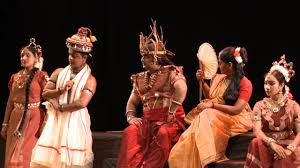
Friday, 5 April 2024

EKAAVALI


EKAAVALI

          Ekaavali was a wife of the king Ekavira, the founder of the Hehaya dynasty.  (Goddess Sri Maha Lakshmi incarnated as a horse and she and Sri Maha Vishnu had a son, Ekvira,who is adopted by a mortal king Ekavira. Ekvira eventually marries a princess,whom he saves from a ogre).  In the 6th Skandha of Devi Bhagavatham it is stated thus.

          Once, the prince Ekavira accompanied by the son of the minister went for a pleasure trip to the banks of the river Ganga.   It was spring and the prince wandering about enjoying the sight of a flowery forest was soon arrested by the sight of a sweet smelling lotus with a hundred petals blooming in the river. 

By the side of the lotus was standing a beautiful damsel weeping.  The prince went to her and asked her the reason for her weeping.  After great persuasion, she replied thus: Oh! Prince! There is a country not far from yours which is now being ruled over by a very righteous king called Raibhya.   His queen is called Rukmarekha.  They had no children for a very long time and so Raibhya conducted a Putrakameshti yaga.  When ghee was poured profusely into the sacrificial fire the flames rose up to great heights and from inside the flames came out a lovely maiden.  The king named her Ekavaliand brought her forth as his daughter. 

I am Yasovati the daughter of the minister there.  We were of the same age and so I was asked to live with her as her companion.  She was very fond of lotuses and the king constructed big ponds with lotuses in them for her recreation.  Yet she used to go to other ponds also in search of lotuses.

One day we came to this side of the river of Ganga to play.  Then a demon of name Kaalakethu came and kidnapped her.  I followed her.  She never surrendered to the enticements and persuasions of Kaalakethu.  Her father wanted her to be married to Ekavira, king of Hehaya.  Kaalakethu sent her to prison.  Without knowing what to do next I am standing here weeping.

Hearing this Ekavira went to Paathaala and defeating Kaalakethu released Ekaavali and brought both Ekaavali and Yasovati to the palace of Raibhya.  Pleased at this, Raibhya gave his daughter in marriage to Ekavira.

It is to be noted that the thousand armed KaarthaViryaarjuna was a descendant of this Hehaya dynasty.

( I'm participating in #BlogchatterA2Z and hyperlink https://www.theblogchatter.com)

Thursday, 4 April 2024

DHAARINI


DHAARINI

Dhaarini was a queen of the king Agnimitra in the play Malavika-Agnimitram in Sanskrit written by the great poet Kalidasa.

Kalidasa’s skill in characterisation comes out best in the female characters of this play.  He presents two opposite types of womanly character, the magnanimous Dhaarini (the queen and the first wife of Agnimitra) and the jealous Iraavati (the queen and the second wife of Agnimitra) whose traits are gradually revealed with the progress of the plot.

No doubt at the outset Dhaarini jealously guards the impressive personality of Malavika (the heroine of the play Malavika-Agnimtram) from the sight of the king (the hero Agnimitra).  She even tries to prevent the scheme of Vidhushaka (jester) to display the dance of Malavika before the king from being carried out, but yields eventually.  As the plot progress, her yields eventually. 

As the plot progresses, her magnanimity asserts itself.  She forgives the faults of the king.  She promises Malavika her desired object if the Asoka tree puts forth blossom in five days.  She is charitable to the Vidhushaka, though conscious of his complicity in the love-intrigues of the king.  She id moved to pity when a snake is supposed to have bitten him and offers him her signet-ring for effecting his cure from poison readily with a demur.  She is tolerant when the misuse of her signet-ring comes to light, and actually sends word to Iravati that she imprisoned Malavika and Bakulavalika (servant maid to Dhaarini) only to respect her wishes, but that she would like to fulfil the desire of the king.

As an ideal Hindu wife, Dhaarini subordinates her interests to those of her husband (the hero and the king Agnimitra).  She is ever cordial and respectful towards his despite his vagaries.  She does not utter a harsh word towards him even under great provocation.  Her utmost hard behaviour towards her erring husband consists in a mere passing thought- “Aho avinaya Aaryaputrasya means alas, the audacity of my lord”.

When the noble heredity of Princess Malavika, comes to her notice, she sincerely repents of having treated her as a maid-servant.  Genial in temper, cordial in words and acts, dignified in behaviour and stately in her manners.

Dhaarini is quite an impressive character.  In her association with the learned Kausiki and gifts to Brahmanic-scholars on hearing her son’s expedition for the steering of the sacrificial horse comes out her religious temperament.  Her attititude towards Malavika beginning from the initiation in dance down to her admittance in the royal harem reveals her kindliness.  Her nobility of character comes out in her acquaintance in the advent of a rival wife, a featurepraised by the learned Kausiki thus “Pratipakshenaapi patim sevanthe bharthruvatsalaah saadhvyah means chaste wives to whom husbands are dear serve their lords even by consenting to the admission of a rival wife”.

In the result Dhaarini remains without a parallel among female characters, perhaps in the whole range
of Sanskrit drama.


( I'm participating in #BlogchatterA2Z and hyperlink https://www.theblogchatter.com)

Wednesday, 3 April 2024

CITRANGADA


Citrangada

Citrangada was the daughter of Citravahana who ruled the state called Manalur.   She was beautiful woman having an enchanting figure that of a Madhuka flower.

When Yudhishthira was closeted with Draupati in amorous talks, Arjuna by mistake entered the room and was thus compelled as per a previous mutual agreement to go on pilgrimage for a year.  During this exile Arjuna married the serpent girl Ulupi.  After that he proceeded again on his pilgrimage, he reached the state called Manalur.(Now Manipur)

Arjuna accidentally saw Citrangada and fell in love with her, and knowing that, the king received Arjuna in his palace and requested Arjuna to marry his daughter.  Arjuna married her and the couple got a son named Babhruvahana.  Promising them that he would come back and take them to Hastinapuram, Arjuna continued his pilgrimage.

After the great MahaBharata war, once Yudhishthira conducted an Asvamedha Yajna (Horse-sacrifice), it was Arjuna who led sacrificial horse to the south.  When Arjuna reached Manalur by following the sacrificial horse, he came against Babhruvahana who challenged him for a fight.  In the grim battle that ensued Arjuna fell dead by the piercing arrows of Babhruvahana, who was his own son.  At that time Ulupi and Citrangada came to the scene and seeing Arjuna lying dead, Ulupi brought the diamond along with Mrutha-Sanjeevani creeper, kept it on the face of Arjuna, brought him back to life.  After this incident, Ulupi, Citrangada and her son Babhruvahana went to Hastinapura along with Arjuna.

Citrangada on reaching Hastinapura bowed down before Kunti and Draupadi, touching their feet and lived amicably with others like Subhadra.  Then, Kunti, Draupadi and Subhadra gave Citrangada many diamonds as present.

After the Mahaprasthana (starting towards to the heaven for salvation) of all the Pandavas, Citrangada left for Manalur.

( I'm participating in #BlogchatterA2Z and hyperlink https://www.theblogchatter.com)

Tuesday, 2 April 2024

BHANUMATI


Bhanumati (wife of Duryodhana)

Bhanumati is the wife of Duryodhana, the main antagonist of the epic MahaBharatam.   Bhanumati's children are Lakshanakumara and Lakshnakumari.

In the Mahabharata, Duryodhana's wife is mentioned thrice. In the book SantiParva, Duryodhana abducted king Chitrangada's daughter from her Svayamvara (Self-choice) with the help of Karna. Later, she is described by her mother-in-law, Gandhari, in the book Stri Parva.

In thebook Salya Parva, Duryodhana expresses his sorrow over the fate of the mother of his son, Lakshnakumara. In the  Stri Parva, Gandhari (mother of Duryodhana) mentions her daughter-in-law. In Santi Parva, the sage Narada narrates a story about the friendship of Duryodhana and Karna. Here, Karna helps his friend in abducting the daughter of Kalinga king Chitrāngada from her Swayamvar. As Duryodhana's wife is unnamed in the epic, her name is provided by the folktales.

Duryodhana's marriage is found in the Shanti Parva of Mahabharata. The tale of the svayamvara of Chitrangada's daughter is narrated by Narada, the divine sage. The text never mentions the name of the princess but states that she is fair and beautiful.

Duryodhana was invited to the Svayamvara of the daughter of King Chitrangada of Kalinga. Duryodhana went to the city of Rajapura, taking along his friend Karna. Many rulers like Sisupala, Jarasandha, Bhishmaka, Vakra, Kapotaroman, Nila, Rukmi, Sringa, Ashoka, Shatadhanvan and others attended the ceremony.

After the commencing of the ceremony, the princess entered the arena with a garland in her hand, surrounded by her nursemaid and bodyguards. As she was being informed about the names of the participants and their lineage, she walked away from Duryodhana. Duryodhana refuses to accept her rejection and already smitten by the princess, took her away on his chariot challenging other suitors to beat him and Karna. Karna successfully battled with the rest of the suitors to protect his friend. Karna easily defeated the pursuing Kings and the other royal suitors abandoned their pursuit after seeing Karna's fighting prowess. On reaching Hastinapura, Duryodhana justified his act by giving the example of his great grandfather Bhishma abducting three princesses of Kasi for his stepbrother, Vichitraveerya.  Finally, Bhanumati consented and married Duryodhana.

Bhanumati was depicted as devoted wife or typical pativrata in the play Venisamharam written by Narayana Bhatta in Sanskrit, based on the plot of Mahabharatam.  As contrasted with Draupadi, Bhanumati is considerably mild.  Even for understanding a vow calculated to secure the safety of her husband, Bhanumati would stand in need of Duryodhana’s permission (आर्यपुत्र, अभ्यनुज्ञातायाः त्वयास्ति मे कस्मिन्नपि नियमेऽभिलाषः।)

From what Sahadeva says, it is also possible, that but for her husband’s evil influence, Bhanumati would not have displayed any crookedness.  He says that indeed the minds of women like those of their husbands on account of association. “मधुरापि हि मूर्च्छयते विषविटपिसमाश्रिता वल्ली” The creeper though sweet, being surrounded by a poisonous tree makes people fall in swoon.  Had it not beenfor Duryodhana’s influence one wonders whether Bhanumati would have taunted Draupadi with the words “अयि याज्ञसेनि पञ्च ग्रामाः प्रार्थ्यन्त इति श्रूयते। तत् कस्मादिदानीमपि ते केशाः न संयन्ते”. Her concern for her husband’s success, Bhanumati also expresses, but in her own tame way and when Duryodhana turns a deaf ear to her caution, she keeps quiet.

( I'm participating in #BlogchatterA2Z and hyperlink https://www.theblogchatter.com)

Monday, 1 April 2024

AVANTI SUNDARI


                                          "Yatra naryastu pujyante ramante tatra Devata,                                                                                       yatraitaastu na pujyante sarvaastatrafalaah kriyaah"                                                                      

is a famous sloka taken from Manusmruthi which means where Women are honored, divinity blossoms there, and where women are dishonored, all action no matter how noble remain unfruitful.

Women must be honored and adorned by their fathers, brothers, husbands, and brothers-in-law, who desire (their own) welfare.

The only daughter is like ten sons. The result of the upbringing of ten sons is achieved only by the nurturing of the girl.

The incomparable radiance that was born from all gods and pervaded the 3 worlds, came to one place and took the form of a woman.

Where the female relations live in grief, the family soon wholly perishes; but that family where they are not unhappy ever prospers.

The houses on which female relations, not being duly honored, pronounce a curse, perish completely, as if destroyed by magic.

Men who seek (their own) welfare, should always honor women on festivals with (gifts of) ornaments, clothes, and (dainty) food.

These are the Sanskrit wise sayings glorify the greatness of women, their power and the indispensable presence.

Hence, I am being a Sanskrit professor, wishing to share the great women characters found in Sanskrit literature

AVANTI-SUNDARI  AN ACCOMPLISHED WOMAN

Avantisundari, an accomplished Chahamana or Chauhan princess, was a rhetorician, poet and writer. She inspired her husband Rajashekhara, a court poet of the Gurjara Pratihara King Mahendravarman and later of the Kalachuri King Yuvaraj I. 

Avantisundari wrote in Sanskrit and Prakrit and her views on aesthetics were treated with respect. Her husband cited her views on poetics in his famous work Kavya-mimansa.

According to her, a poetical composition that gives pleasure to connoisseurs should be looked upon as perfect. Though she and her husband had different views, they nevertheless seem to have been able to work and write together. 

Rajashekhara quotes Avantisundari as saying that a suitable subject for poetry is made so by the possession of several traits or qualities, and that the expression of one or more of these traits constitutes the style and eloquence of a poet. 

Three of Avantisundari’s stanzas are cited in Hemchandra’s Desi-naamamaalaa, where the meanings of certain Prakrit expressions are illustrated. 

Unfortunately no more of her work has been discovered.


( I'm participating in #BlogchatterA2Z and hyperlink https://www.theblogchatter.com)

Sunday, 24 March 2024

THE BATTLE OF VATHAPI BOOK 2 - VARAHA’S VENGEANCE


Author: Arun Krishnan

Publisher: HarperCollins India

Genre: Mythology & History

Book buy link: @Amazon

Dr. Arun Krishnan, the author of this book titled ‘Varaha’s Vengeance’ is a polyglot who has studied and lived in different cities across the world and settled now in Bangalore.  He can be reached through his Twitter @ArunKrishnan_ and Instragram @authorarunkrishnan.

“The Battle of Vathapi Book 2 – VARAHA’S VENGEANCE” is his second work of fiction.

 In this book the author vividly describes about how the Pallava Emperor Mamalla Narasimha -the great gained his sovereignty by defeating the Chalukya king Pulikesi.  

Narasimhavarman I, also known as Narasimha Pallava, was a prominent ruler of the Pallava dynasty in South India during the 7th century CE. He defeated Pulakeshin II, the powerful Chalukya king, in the Battle of Vatapi in 642 CE. This victory marked a significant turning point in South Indian history, leading to the decline of Chalukya power and the expansion of Pallava influence in the region.


“An enemy’s enemy is a friend and all that” is from page 22 of this book-

उद्विजेत च मैत्रीयं शत्रूनुद्विजयेन च। अयुद्धानि च संयुक्तं तेन तेनान्यदूरतः॥

"Make peace with those who are upset and join forces with those who are fighting enemies. Through these means, one can defeat those enemies who are further away."

This verse emphasizes the importance of making peace with discontented parties and forming alliances with those who share common enemies. It suggests that by leveraging conflicts and alliances wisely, one can effectively deal with distant adversaries. This aligns with the concept of "an enemy's enemy is a friend" as it highlights the strategic value of exploiting the enmity between adversaries for one's advantage.

The concept of leveraging the enmity between adversaries for strategic advantage is consistent with the principles of diplomacy and statecraft.

Next the author emphasized the virtues of cooperation, understanding, and empathy among rulers and leaders. These texts often portray conflicts arising from internal discord and the detrimental effects they have on society.

These lines are from Page 25 where

“This is not the time for recriminations or for fighting amongst ourselves. I know that you are all facing pressures in your respective kingdoms, as am I, in mine”.

We can draw parallels with the teachings found in the Arthashastra and Mahabharata contain numerous dialogues regarding the importance of unity, cooperation, and diplomacy in times of adversity.

In Page 40-

“This is fate of a woman.  Listen to her father when young, then listen to her lover or husband.  I can’t decide for myself ever, I suppose”.

This phrase reflects a historical societal perspective prevalent in certain ancient Indian texts and cultural norms, where women were often considered to have subordinate roles and limited autonomy compared to men. "न स्त्री स्वातन्त्रमर्हति" (na strī svātantryamarhati) means "A woman does not deserve independence."

In traditional Indian society, women were expected to adhere to societal norms and were often subject to patriarchal control.

 The author should note that the Rishi is Agasthya not Vasishtha.  (Please refer AGNI PURANA, chapter 7) This is in reference to the lines in page 54 of the book- “When the brothers had tried this with the great Rishi Vasishtha, he had eaten the proffered meal and then killed Vathapi by promptly digesting him”.  

In Page 93 of the book, the phrases advocate for a mind-set of coexistence, conservation, and respect for the natural world, recognizing the interconnectedness of all living beings and the importance of preserving ecosystems for future generations.

 I quote -“Drove it off?  Not killed”.  “Why should I kill it?  The forest is its home”. This shows the recognition of the tiger's intrinsic value and right to inhabit its native environment. It reflects a broader ethos of ecological stewardship and biodiversity conservation, where humans are encouraged to live in harmony with wildlife rather than dominating or eradicating it. 

 "प्रमाणं कुर्वीत" (Pramāṇaṁ kurvīta) means "Let them establish the evidence."  It reflects the principles of verification and evidence-based decision-making, which are essential in governance and leadership.

This can be found in page 100, “You can always send some scouts out along the road and check if I am correct or not.  In the worst case, I will be proven to be a liar and you can send me to the dungeons”.

 The Chapters 13& 17 mainly deals about different warfare activities thoroughly.  Karivalan and Senthan the main captains in the Pallava army defeated Pandya’s army. Both of them involved with the purpose of doing what was dear to their king Narasimha. 

 This description can remind the readers that in Sanskrit, Mahakavi Bhasa described the battle that “AnyonyaSastraVinipata……” means in great battles wherein the bodies of soldiers, horses, elephants and chariots are shattered by weapons hurled each other.

In this battle Karivalan felt elated because the opportunity to display his maximum valour has come.  Karivalan defeated Pandya’s army but Chaminda was defeated by Tribhuvana’s army.  In these chapters one can feel the spirit of the valour of soldiers.    In this context, the same idea echoes the phrase from Bhagavad gita “Hato Vaa Praapsyasi Svargam” means if one slain in battle, there is no loss but only gain because he goes to heroic divine abode i.e heaven.  If victorious, he gets fame, wealth and country.  Both victory and death while fighting face to face in the battle field, are praise worthy and are held in great esteem by the people.

In the 19th chapter, the author highlighted through Sadaiyan’s idea “I know what we can do.  Why don’t we destroy their catapults?” (Page 177) that on those days even a thief knew the policy of state crafts.

The effective loveable anecdotes related with Elango and Indu; and Muthuvel and Thamarai makes the reader to feel the aesthetic pleasures. 

Though the author described the enchanting romantic phrases, he had never failed to display the courage of patriotism of the character Indu through the words of Somanna the Prime Minister of Gangas that “Our land is indeed blessed that she has given birth to daughters like her”.

 The author nicely picturised the event in which the Commander Narasimha of Gangas and his team though killed Annamalai of Thagadur, they have not celebrated the death of Annamalai.

 Finally we can understand that Narasimha Pallava, defeated Pulakeshin II, the Chalukya king, through strategic military manoeuvres and decisive tactics. He likely employed a combination of superior military strategy, skilled leadership, and possibly alliances with other regional powers Thagadur, Gangas and Banas to gain the upper hand in the Battle of Vatapi.

Though exact details of the battle and Narasimhavarman's strategies are not extensively documented, but his victory over Pulakeshin II contributed to the decline of the Chalukya dynasty and strengthened the position of the Pallavas in South India.

 Soulful life experience of eminent South Indian soldiers who faced tough times and how they managed the crisis were eminently described in this book.

 Thus, the author has narrated this great story with available documents along with his marvellous descriptive skill and made the readers to visualize the ancient India and enjoy the historic essence.


(This blogpost is a part of Blogchatter's  book review program)

(If you like to read the review of the book -1 of The Battle of Vathapi, Just click here)

Thursday, 7 March 2024

MAHA-SIVA-RATRI THE DAY FOR LORD SIVA


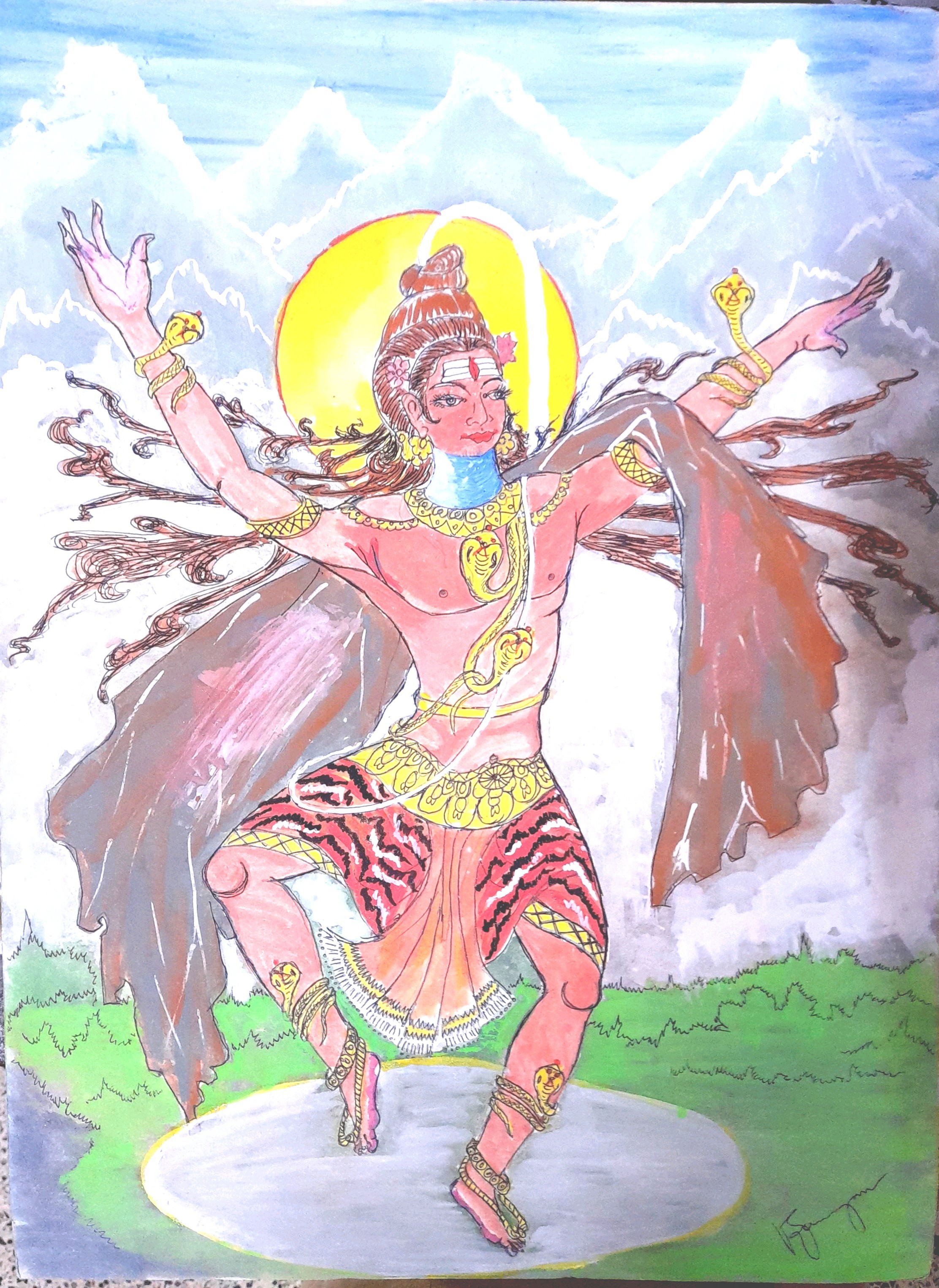
(The above painting is drawn by me)
         
        According to the traditional term “GOD”, Lord Siva is the third member of the Hindu Trinity representing Godhead in Its aspect of Anihilator, in charge of ‘constructive-destruction’ in the continuous process of creation, preservation, destruction and re-creation or transformation.  Siva is the god of austerity. His consort is Goddess Parvati.  He is clad in a deer-skin (elephant-skin according to scripture-Krithivaasa) besmears his body with holy ashes, has matted hair, and is adorned with serpants round his neck and arms.  He is said to have drunk cup of poson which has made his neck blue in colour, giving him the appellation ‘Neela kanta’= the blue-necked god.

        He is said to be seated in deep meditation on the top most point of the world on Mount Kailas on the Himalayas facing the south.  In this aspect, he is known as DakshinaMurti the embodiment and dispenser of the supreme Knowledge.  He has a third eye in the centre of his forhead, the eye of wisdom as well as annihilation. 

        Tomorrow is the auspicious day called Mahasivaratri. (08.03.2024)

        We the devotees of Lord siva, will keep vigil during the night of Sivaratri and worship Him at midnight because the prime manifestation with a form of the formless Isvara is known as the Lingod-bhava Murti. Let us chant “Om Namas Sivaya”.  

        And chant the following also:-

 Śrī mārgabandhu stōtram

śambhō mahādēva dēva  śiva śambhō mahādēva dēvēśa śambhō
śambhō mahādēva dēva ||

phālāvanamratkirīṭaṁ phālanētrārciṣā dagdhapañcēṣukīṭam |
śūlāhatārātikūṭaṁ śuddhamardhēnducūḍaṁ bhajē mārgabandhum || 1 ||

śambhō mahādēva dēva ||

aṅgē virājadbhujaṅgaṁ abhragaṅgātaraṅgābhirāmōttamāṅgaṁ
ōṅkāravāṭīkuraṅgaṁ siddhasaṁsēvitāṅghriṁ bhajē mārgabandhum || 2 ||

śambhō mahādēva dēva ||

nityaṁ cidānandarūpaṁ nihnutāśēṣalōkēśavairipratāpaṁ
kārtasvarāgēndracāpaṁ kr̥ttivāsaṁ bhajē divyasanmārgabandhum || 3 ||

śambhō mahādēva dēva ||

kandarpadarpaghnamīśaṁ kālakaṇṭhaṁ mahēśaṁ mahāvyōmakēśaṁ
kundābhadantaṁ surēśaṁ kōṭisūryaprakāśaṁ bhajē mārgabandhum || 4 ||

śambhō mahādēva dēva ||

mandārabhūtērudāraṁ  mandarāgēndrasāraṁ mahāgauryadūraṁ
sindūradūrapracāraṁ  sindhurājātidhīraṁ bhajē mārgabandhum || 5 ||

śambhō mahādēva dēva ||

appayyayajjvēndra gītaṁ  stōtrarājaṁ paṭhēdyastu bhaktyā prayāṇē
tasyārthasiddhiṁ vidhattē mārgamadhyē:’bhayaṁ cāśutōṣō mahēśaḥ || 6 ||

śambhō mahādēva dēva  śiva śambhō mahādēva dēvēśa śambhō
śambhō mahādēva dēva ||

Ithi śrī mārgabandhu stōtram ||

VĀMANA BHAṬṬA BĀṆA: LIFE AND SANSKRIT WORKS

  Vāmana Bha ṭṭ a Bā ṇ a ( वामनभट्टबाण) was a Sanskrit poet, dramatist, and prose writer associated with the later classical period of Sans...