Saturday, 13 April 2024

LOPAAMUDRA


LOPAAMUDRA

          Lopaamudra was the daughter of the king of Vidharbha and  wife of the great sage Agastya.

          She is said to be have been formed by the sage Agastya himself from the most beautiful parts of different animals so as to have a wife after his own heart, and then secretly  introduced into the palace of the king of Vidharbha where she grew up as his daughter.  She was afterwards married by Agastya.

          He was asked by her to acquire immense riches before be thought of having any connection with her.  The sage accordingly first went to the king Sruthavarman, and from him to several other persons till he went to the rich demon Ilvala and, having conquered him, got immense wealth from him and satisfied his wife.


(I'm participating in #BlogchatterA2Z and hyperlink https://www.theblogchatter.com)

Friday, 12 April 2024

KAADAMBARI


KAADAMBARI

          Kaadambari is the heroine of the story KAADAMBARI an excellent book of love story in prose written in Sanskrit by the great poet Baanabhatta who was a protégé of king HarshaVardhana of the 7th century A.D.

          Kaadambari, the heroine is introduced rather too late in the story and it will not be entirely wrong if we say that the author Baanabhatta has not done full justice in her character, particularly when we compare her with her friend Mahaasvethaa.  Yet Kaadambari leaves a good impression in the reader’s mind as an embodiment of beauty and feminine virtues.

          Being the daughter of the Gandharva chief Chithraratha and the beautiful Apsaras Madhiraa, she inherited a physical charm that was really captivating.  Her name Kaadamnbari (another meaning Wine) is Anvartha (the word follows the meaning) as she would intoxicate anyone who drinks her beauty.

          Kaadambari’s love and regard for Maahasvethaa with whom she was brought up from the childhood, was sincere and deep.  When she heard that Mahaasvethaa had decided to remain in the forest and do penance on account of her disappointment in love, she also took a vow not to marry as long as her friend remained in that state.

          She asked Mahaasvethaa how she could enjoy married life when her friend was in that pitiable condition.  Mahaasvethaa knew that love is blind and powerful and rightly thought that a meaning with Chandraapeeda (the hero of the book Kaadambari) would bring about the desired change in her mind.

          Even at first sight, Kaadambari fell in love with Chandraapeeda and her passion was irresistible.  Even the thought of her parents and her vow could not divert her mind from Chandraapeeda.  She was sincere and firm in her love.

          When Chandraapeeda fell down dead, she decided to follow him.  When she was consoled by the Moon and was asked to preserve the body of Chandraapeeda, she did with it great devotion herself leading the life of an ascetic.  With a ‘strong will’ she controlled her feelings and offered her respects to Thaaraapeeda and Vilaasavathi (the parents of the hero Chandraapeeda) who came to the forest hearing the sad news of their son.

(I'm participating in #BlogchatterA2Z and hyperlink https://www.theblogchatter.com)


Thursday, 11 April 2024

JAAMBAVATI


JAAMBAVATI

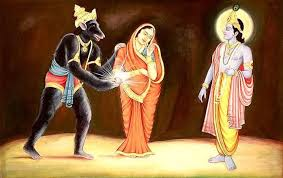
Jaambavati was a daughter of famous Jaambavan.  According to the 4th chapter of Devi Bhagavatam, Sri Krishna went in search of the famous precious stone Syamantaka which was lost when Prasena wore it and went to the forest for hunting.  Krishna found it in the cave of Jaambavan, who fought with him and was defeated.  Finally he gave his daughter Jaambavati to Sri Krishna as wife, and the jewel Syamantaka as dowry.

Sri Krishna came to his capital Dvaaraka with his wife Jaambavati.  When sons were born to the other wives of Krishna, she became sad and requested her husband that sons may be born to her also.  On hearing this request, Krishna went to the mountain where the hermit Upamanyu was engaged in penance.  With that hermit who was an ardent devotee of Siva, as his teacher, Krishna began a penance before Siva, in accordance with Upamanyu’s advice.

The penance, holding Yogadhanda and Kapaala (devotee’s staff and skull) lasted for a month.  In the second month penance was performed standing on one leg and drinking only water.  In the third month he did penance standing on toes only, and using air as food.  After six months Paramasiva appeared and blessed him that his wives would have ten sons each.  Accordingly Jaambavati gave birth to her first son who was named Saamba.


( I'm participating in #BlogchatterA2Z and hyperlink https://www.theblogchatter.com)


Wednesday, 10 April 2024

IRAAVATI


IRAAVATI

Iraavati was a queen of the king Agnimitra (the hero)in the play Malavika-Agnimitram in Sanskrit written by the great poet Kalidasa.

Kalidasa’s skill in characterisation comes out best in the female characters of this play.  He presents two opposite types of womanly character, the magnanimous Dhaarini (the queen and the first wife of Agnimitra) and the jealous Iraavati (the queen and the second wife of Agnimitra) whose traits are gradually revealed with the progress of the plot.

          Iraavati presents a strange contrast to Dhaarini.  She is very particular about her personal charms and asks her servant-maid Nipunikaa whether she appears attractive in her drunkenness.  She is a matter-of-fact lady that is legitimately jealous of a rival participant in the king’s love.  The superior personality of Malavika (the heroine of this play) strikes her with terror and envy.

          Her jealousy leads her to constant eaves-dropping at many an interview between the king and his new love (Malavika).  An undignified coquette, she loses her temper at the infidelity of the king.  She bluntly interrupts the interview of the king and the heroine with her angry words “Pooraya, pooraya.  Ayamasokah kusumam na dharsayati.  Ayam punah pushyathi phalathi cha” means Fructify, fructify.  The tree Asoka does not put forth flowers.  But this one does put forth flowers and also bears fruit.

          Iraavati addresses sarcastic remarks to Malavika and threatens her accomplice Bakulaavalikaa.  She taunts her husband with the word “Sata” means rogue and beats him with her girdle and refuses to be reconciled even by his prostration, knowing as she did that his apologies were in-sincere. 

          Exasperated by the king’s courtship to his new love, she induces queen Dhaarini to put Malavika and her maid in prison.  At the second interview too, already enraged that she is at the mutter of Vidhushaka in dream for Malavika, Iraavati is further incensed at the release of Malavika, and though she suspects the queen Dhaarini’s partiality at the outset, accuses the Vidhushaka in strong terms when she comes to know that it was the trick of Vidhushaka.

          The queen Dhaarini’s tolerance leaves Iraavati no alternative except to submit to the inevitable, but it is the character of Iraavati round which the whole plot of the play Malavikagnimitram turns and but for her this paly would have lost much of its interest.

( I'm participating in #BlogchatterA2Z and hyperlink https://www.theblogchatter.com)

Tuesday, 9 April 2024

HIDIMBAA


HIDIMBAA

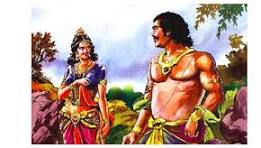
Hidimbaa was a wife of Bhima and mother of Ghatotkacha.  On the burning of the “Lac Palace” the Pandavas escaped through a tunnel and reached a forest.  Bhima saw his brothers and mother feeling tired and sleepy. So, he carried them on his shoulder, ran very fast and kept them under banyan tree safe. When they were resting, he was guarding them vigilantly. At this juncture, a demoness named Hidimba was roaming in the forest with his brother demon Hidimban. Hidimban ordered her to bring those five for eating them. But on seeing the extra ordinary power and appearance of Bhima, she requested him to marry her.

Due to delay her brother came there and started fighting with Bhima in which the demon got killed by Bhima. The other Pandavas woke up on hearing the deafening sound of the demon. But Hidimba fell at their feet to permit her to marry mighty Bhima. As permitted she got married with him and delivered a strong boy immediately who was called Ghatotkacha. He also grew as young very fast and departed from there with his mother Hidimba to her abode.

( I'm participating in #BlogchatterA2Z and hyperlink https://www.theblogchatter.com)

Monday, 8 April 2024

GHOSHAA


GHOSHAA

          Ghoshaa was a Tapasvini famed in Rugveda.  She was the grand-daughter of Drugata maharshi and daughter of the sage Kakshivaan both composed several hymns in praise of the Ashwins. Two entire hymns of the Tenth book, each containing 14 verses, are attributed to her. 

Ghosha was one of the 27 women known as brahmavadinis, though some of these ‘women’ seem to have been abstractions or fictions. Ghosha is one who appears to have been human, and the author of two hymns in the Rig Veda.  

As she contracted leprosy in her very childhood nobody came forward to marry her.  Ultimately she composed a mantra in praise of Asvinidevas.  They cured Ghoshaa of leprosy and she got married.

Her first hymn praises the Ashwins, the heavenly twins who are also physicians; this accords well with the legend that she suffered from some disfiguring disease, perhaps leprosy, and remained unmarried as a consequence in her father’s house.

The first, a more personal one, expresses Ghosha’s intimate feelings and desires. She implored the Ashwins,

This praise song have we made for you, O Ashwins,
Have fashioned it as the Bhrigus build a weapon
Have decked it as the bride is for the bridegroom,
Presenting it to you as our own offerings.

It is said that, invoked by her two hymns, the Ashwins worshipped by her forefathers cured her of the disease and made her worthy of wedded happiness.

The second hymn is explicit about her desires and deep feeling for married life:
The woman has been born:                                                                              let him, desirous of a maiden, approach her;
For him let the spreading creepers grow along with rain;
Let the stream flow for him as if down an incline;
For him who is not to be conquered, let there be the rights of a husband.

( I'm participating in #BlogchatterA2Z and hyperlink https://www.theblogchatter.com)

Saturday, 6 April 2024

FESHIKHA SIRINDHORN.


FESHIKHA SIRINDHORN

Feshikha means Princess.  Sirindhorn, a 60-year-old scholar of Sanskrit who was the Royal Patron of the World Sanskrit Conference held in Bangkok last year, will be travelling to India in this regard, secretary (East), ministry of external affairs, Anil Wadhwa said. “Princess Maha Chakri Sirindhorn will be travelling to India to receive the first world Sanskrit Award which has been conferred on her by the government of India,” said Wadhwa, who was accompanying Ansari during his visit to Thailand. 

The sixteenth conference in Bangkok, Thailand in 2015 received unprecedented support from the Indian government.  Over 600 Sanskrit scholars from 60 countries participated in the five-day conference last year which was inaugurated by external affairs minister Sushma Swaraj.

Before leaving for home, Ansari called on Princess Sirindhorn at the Sra Pathum Palace this morning and inspected the Chitralada Project inside it.

Hers will be among the several visits by top Thai leaders expected this year including Prime Minister General Prayut Chan-o-cha, Prince Maha Vajiralongkorn and Deputy Prime Minister and Defence Minister Prawit Wongsuwon.

Wadhwa also lauded Thailand for successfully hosting the 16th World Sanskrit Conference.

( I'm participating in #BlogchatterA2Z and hyperlink https://www.theblogchatter.com)

VĀMANA BHAṬṬA BĀṆA: LIFE AND SANSKRIT WORKS

  Vāmana Bha ṭṭ a Bā ṇ a ( वामनभट्टबाण) was a Sanskrit poet, dramatist, and prose writer associated with the later classical period of Sans...