Thursday, 22 February 2024

SANSKRIT IN THE REIGN OF TRAVANCORE SAMSTHAN


          The history of Modern Travancore starts with the king Martanda-Varman who ascended the throne in 1729 A.D.  Though he was not known to have write any work, he was certainly a generous patron of literature, and in his court flourished many of the scholars and poets of Kerala at that time.  Among them, the scholar poet Ramapanivada, Devaraja of Asramam and poet KrshnaSarman etc., were highly renowned.

          RamaPaniVada was a great scholar and prolific writer both in Sanskrit and in Prakrt. He has many credits by authoring several works of outstanding merit covering almost all branches of general literature.  His Vithi - street play named Candrika Vithi was written on the occasion of the Sivaratri festival at Triprangot temple.  Being patronised by Martanda-Varman the maker of Modern Travancore, he wrote a drama called SitaRaghavam.


          The poet Devaraja was the author of a historical play titled Bala-Martanda-Vijayam in five acts which deals with the king’s dedication of the entire realm to Lord Sri Anantha Padmanabha of Trivandrum temple.

          Another protégé of the king MartandaVarman, poet KrshnaSarman was the author of Sri Padmanabha Carita Campu dealing with the story of the origin of the Lord Sri Anantha Padmanabha Svami Temple at the city Trivandrum.

Wednesday, 21 February 2024

SANSKRIT IN THE REIGN OF MANAVIKRAMA OF KOZHIKODE - Part II


    Among the nineteen poets patronized by the king ManaVikraman, Uddanda Sastri alias Uddanda Kavi has praised his patron the king ManaVikraman in his works KokilaSandesam - a lyrical poem  and the play  Mallika-Marutam.  Among those nineteen poets, Uddanda Kavi was little haughty and overbearing.

KokolaSandesam is modelled after Kalidasa’s MeghaSandesam.  In the kokilaSandesam, a message is sent through a bird Kokila (Cuckoo) by a lover from Kanchi in the Chingleput districts of the Madras Presidency to his sweetheart in Chendamangalam (Jayantamangalam).        

MallikaMarutam is an imitation of Bhavabhuti’s MalatiMadhavam in 10 acts and belongs to Prakarana type.  It describe the story of the love between Mallika, daughter of Visvavasu who is the minister of Vidyadhara king, and Maruta, the son of Brahmadatta who is the minister of the king of Kuntala.

Another scholar and a descendent of Payyur Bhattas, among the nineteen poets, was none another than Paramesvara I, who was the son of  Rsi I and Gauri.  He was a great scholar, critic and poet.  He has authored several works viz., Sumanoramani a commentary on MeghaSandesam, Jushadhvamkarani and Svaditankarani commentaries on Vacaspati-Misra’s NyayaKanika, HariCarita - a short poem in praise of Lord Vishnu and NyayaSamuccayam - a work on Mimamsa system.

This Paramesvara I had five sons: Rsi I, Bhavadasa II, Vasudeva I, Subrahmanya and Sankara.  They also like their father became renowned by their erudition in the Sastric and poetic field and ceaselessly passed over the same through their lineage.

Tuesday, 20 February 2024

SANSKRIT IN THE REIGN OF MANAVIKRAMA OF KOZHIKODE


          One of the most important centres of Sanskrit studies in Kerala during the middle ages was the court of the Zamorins of Kozhikode also known as Calicut.  There were many scholars and poets in that royal family who contributed substantially to Sanskrit literature; the number of scholars patronized by them is also very great.  Among these Zamorins of Kozhikode, ManaVikraman Saaktan Tampuran of 1427 A.D., was the earliest and the most outstanding.

          According to popular traditions there were nineteen poets as the Padinettaraik Kavigal or ‘the eighteen and a half poets’, in the court of ManaVikraman.  Of these Punam Nambutiri was called the ‘Half poet’, he was only a Malayalam poet, and not a recognized Sanskrit scholar.

          Among the nineteen poets, DamodaraBhatta who was patronized by the king ManaVikraman, was the author of VasumatiManaVikramam a play in seven acts.  It describesthe story of ManaVikraman’s marriage with Vasumati, daughter of his minister Mannaat Achan. 

Monday, 19 February 2024

SANSKRIT IN THE REIGN OF KOLATTIRI ROYAL FAMILY


The Mushaka kingdom is narrated from legendary beginnings in a Sanskrit poem called MUSHAKAVAMSAM gives the history of the land till about the 12th century A.D.  Later the kingdom came to be known as Kolattunadu and the kings as Kolattiris.

There was a Mushaka king by name Srikanta alias Rajadharman in 12 A.D., in the North region of Kerala.  The court poet Atula was patronized by him.  The poet Atula composed a historical Mahakavya by name MUSHAKAVAMSAM of which only 15 cantos are available now.  It starts with the story that once the warriors were slaughtered by Parasurama, a queen, whose husband was killed, escaped from her kingdom to the mountain Eli, being escorted by a priest, and hid herself in a cave there.  One day a rat as big as an elephant entered the cave and threatened to devour the queen, but was burned to ashes by the queen’s anger.  Then the rat appeared before her as Parvataraja, the king of mountain, and said that he was now saved from the curse of sage Kusika which had brought him to his previous plight.  Then the queen continued to live in the cave and brought forth a male child, who was the properly educated by the priest.  Being born in a cave of the Mushaka-mountain, and being consecrated with a potful of water by Parasurama, the prince came to be known as Mushaka Ramaghata.   

            In the 14th century A.D., King Raghava came to power.  A court poet by name Divakara being patronized by him, composed a Mahakavyam titled AnargaRaghavaCampu on his patron. 

          In the beginning of 15th century A.D., a royal prince of the Kola country named RamaVarman the elder brother of KeralaVarman.  After the death of RamaVarman, KeralaVarman, has ascended the throne.  RamaVarman has authored BharataSamgraham  a MahaKavyam dealing with the story of the Mahabharatam in 25 cantos, and a play, CandrikaKalapidam in 5 acts describing the story of the love between Candrika, the daughter of the king of Kalinga, and KandarpaSekhara, king of Kasi, culminating in their marriage.

          King KeralaVarman of Kolattunadu was a very great patron of letters.  He had in his court great scholars and poets like Raghava the commentator of YudhishthiraVijayam and his disciple Sankara the author of Mahakavyam  KrishnaVijayam in 12 cantos.

Sunday, 18 February 2024

SANSKRIT IN THE REIGN OF MAHODAYAPURAM KULASEKHARAS


          In ancient Kerala there were several famous kings who called themselves Kulasekharas.  Their capital was Mahodayapuram at the mouth of the Periyar River, which may be identified with modern Tiruvancikulam in Cranganore.   Kulasekhara seems to have been a title assumed by the Kerala kings at the time of their coronation, for we know at least three Kulasekaharas whose proper names were different: Ravivarman Kulasekhara, patron of the famous astronomer Sankaranarayana, Ramavarman Kulasekhara, patron of the Yamaka poet Vasudeva, and Sri Kulasekhara Azhvar who may be considered as the author of Mukumdamala, are the most outstanding among them.

          1. Kulasekhara Azhvar, the Vaishnava saint was born as an incarnation of Vishnu’s Kaustubam.  According to Vaishnava tradition, Tiruvanchikkulam is birth place and 3075 B.C., is the year of birth of Kulasekhara Azhvar whose father was Drudavrata, king of Kerala. 

          After coming to throne, he conquered the Pandya and Cola kingdoms, and became the emperor of the whole South India.  He has written a short and sweet devotional poem Mukundamala in Sanskrit.  The language is quite simple and natural.  Owing to the great popularity of the poem, there are various recensions of the text, each different from others in the number of verses and in the arrangements.

          2. The royal dramatist Kulasekhara who belongs to 900 A.D., was the author of TapatiSamvaranam and SubhadraDhananjayam.  From the prologue of TapatiSamvaranam, it is clear that he was Emperor of Kerala, that he had his capital at Mahodayapuram or modern Tiruvancikulam.  TapatiSamvaranam is a drama with six Acts, describes the story of the love between Tapati, daughter of the Sun-god, and Samvarana, the king of Hastinapura.  The plot of the play is taken from Adiparva of Mahabharatam.

SubhadraDhananjayam describes, in five Acts, the well known story of Arjuna’s abduction of Subhadra, from Dvaraka.  The fame of Subhadra’s beauty attaracts Arjuna.

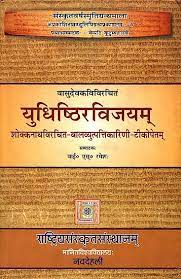
          3.  Ramavarman Kulasekhara who flourished by about 900 A.D., who had his capital at Mahodayapuram modern Tiruvancikulam was the patron of the Yamaaka Poet Vasudeva Kavi the author of YudhishthiraVijayam.


          The YudhishthiraVijayam describes the story of the Mahabharatam in eight cantos, called Asvasas or Uchvasas, containing about one thaousand verses, mostly in the Arya metres.

Saturday, 17 February 2024

SANSKRIT IN THE REIGN OF KUMĀRADĀSA


          Some of the occupants of the throne were themselves scholars.  This can be understood by knowing the legacy of some royal people. One among such of them the author of JanakiHaranam is identified with King Kumaradasa of Cylon.  Kumaradasa also called Kumara Dhatusena was a king of Anuradhapura, Cylone in the 6th Century A.D., whose reign lasted from 515 to 524.  He succeeded his father Moggallana I as king of Anuradhapura and was succeeded by his son Kittisena.  

Jānakīharaṇam written by Kumāradāsa is one among the earlier Mahā-kāvyas in Sanskrit literature. It consists of 20 Cantos.  He was born blind and was helped in getting his kingdom and in writing this poem by his two maternal uncles.  The colophons of the manuscripts to each canto mention the Sinhalese nativity of the poet:- “Iti simhalakaveh Kumara-dasasya krtau Janakiharane mahakavye …… sargah”.   It is to be noted that the Trivandrum transcript has at the end of the poem a small verse in the form of phalaśruti which runs thus, “Janakiharanam slakshnam lakshanairupalkshitam, Ramayanasudhasaram asvadyam mukti-dayakam”.

          Alaṅkāra writers like Hemacandra (1089 to 1173 A.D.), and Bhoja (1010 TO 1055 A.D.) also quote from Kumāradāsa’s work.  Next comes the important author, Rājaśekhara of C. 900 A.D., who makes some references to Kumāradāsa.  In his Kāvyamīmāmsā he refers to the poet as born blind.  He has also left a verse on Kumāradāsa and his poem:- “Janakiharanam kartum Raghuvamse sthite sati, Kavih Kumaradasasca Ravanascayadi kshamah” means, “To have produced an Abduction of Sita, When the Dynasty of Raghu was present before him-“One must have been Kumāradāsa or else been Rāvaṇa”.  Though there are different opinions on the date of Kumāradāsa, many Sanskrit scholars accepted to assign Kumāradāsa here to the beginning of the 6th Century.

Kumāradāsa was a great poet with innate literary talents.  He was quite at ease in handling chaste words of exquisite beauty.  His utterances suit the occasion even by their mere sound effect. 

In the art of description he has shown his compo-sing proficiency with high order.  His imaginations are so vivid and graphic.  He displays his skill in Sabdalankaras i.e., figurative poetry especially Yamakam (Chime)in canto 17.  The poem is written in an easy flowing style and shows unmistakable evidences of Kalidasa’s influence.

Friday, 16 February 2024

SANSKRIT IN THE REIGN OF PRATAPARUDRA


PratapaRudraDeva of Kakatiya dynasty ruled at Warangal region of Andhra Pradesh, in between 1268 to 1325 A.D.  The renowned poet Vidyanatha adorned his court.  He has composed an alankara (Rhetoric) work titled PratapaRudraYasoBhushanam with 3 chapters namely KavyaPrakaranam, RasaPrakaranam and NatakaPrakaranam. It also contains a drama called PraparudraKalyanam with 5 Acts for illustrating the rules of dramaturgy.  It describes the accession of prince PratapaRudra to the throne.


All the illustrations in this work are composed by the author himself exploiting the merits and exploits of ViraRudra or PratapaRudra who was his patron.  This work contains some historical information about ViraRudra and the Kakatiya dynasty.

VĀMANA BHAṬṬA BĀṆA: LIFE AND SANSKRIT WORKS

  Vāmana Bha ṭṭ a Bā ṇ a ( वामनभट्टबाण) was a Sanskrit poet, dramatist, and prose writer associated with the later classical period of Sans...