Monday, 4 September 2023

KUSA


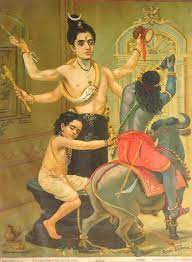
Kusa was a son of Sri Rama and Sita.  When Sita was forsaken by Rama in the forest, Valmiki has given the refuge to Sita.  She was pregnant on that time.  Lava was born in the asramam of Valmiki.

Once Valmiki who didn't know that Sita took Lava to the stream to bathe him, when he returned the asramam. He became upset not to see the child Lava there.  He feared that it might have been eaten up by some animal, and fearing that Sita might die when she missed the child.  Valmiki created a child with Kusa grass and laid him where Lava was laying before.

When Sita returned to the asramam with Lava after their bath, Valmiki explained the whole situation to Sita.  Since the second child was created with Kusa grass, he was made the second son of Sita and named meaningfully KUSA.

Kusa gained his education along with Lava from the Sage Valmiki.  Both of them became very intelligent got the mastry in the archery even in their young age.  They learnt the secrets about divine arrows. 

One day Kusa with Lava, captured the sacrificial horse of Asvamedha Yajna of Sri Rama, which was followed by Satrughna.  Satrughna could not defeat Kusa and Lava even with the help of Lakshmana.  Then Valmiki intervened and the sacrificial horse was returned to Satrughna.

Once, Kusa along with Lava visited the city Ayodhya, entered the court and started to recite the Ramayanam written by Valmiki in front of Sri Rama.  Then Sri Rama came to know about them as His sons and made them both to live in his palace.

(This blogpost is a part of Blogchatter's Half Marathon 2023)

Sunday, 3 September 2023

LAVA


Lava was a son of Sri Rama and Sita.  When Sita was forsaken by Rama in the forest, Valmiki has given the refuge to Sita.  She was pregnant on that time.  Lava was born along with Kusa in the ashram of Valmiki.

Lava gained his education along with Kusa from the Sage Valmiki.  Both of them became very intelligent got the mastery in the archery even in their young age.  They learnt the secrets about divine arrows. 

Once, being instructed by Valmiki, Lava went to the mount Kailasa  and after killing many Yakshas, collected the golden lotus flowers from Kubera's pond and other flowers of Kalpakavruksha from Kubera's garden, to worship Sivalinga.

One day Lava with Kusa, captured the sacrificial horse of Asvamedha Yajna of Sri Rama, which was followed by Satrughna.  Satrughna could not defeat Lava even with the help of Lakshmana.  Then Valmiki intervened and the horse was returned to Satrughna.

After some time, Lava along with Kusa visited The city Ayodhya, and recited the Ramayanam written by Valmiki in front of Sri Rama. 

Rama recognized Lava with Kusa and made them both to live in his palace.

(This blogpost is a part of Blogchatter's Half Marathon 2023)

Saturday, 2 September 2023

THE EMPRESS OF INDRAPRASTHA PART - II


 Author : Sonali Raje

Publisher: Vishwakarma Publication

Genre: Mythology and History

Buy the book in Amazon : here

Written by the author Sonali Raje the book “The Empress Of Indraprastha – Building An Empire – Part II”  with  nineteen chapters and more than 200 odd pages is very interesting one. It makes the reader to recall the characters of the great epic MahaBharata the most voluminous work in this world.  Though it is weaved with the real themes taken from that famous epic, the author innovatively elaborated the incidents, celebrations, conversations which can’t be found in the original.  Especially the women characters particularly the character of Draupadi was portrayed in befitting manner.  Here the important phrases are being reviewed to feel and cherish the aesthetic pleasure of this fine novel literature.

The cover page was well designed by the illustrator which make the readers to visualize the Character of Draupadi.   

The author Sonali Raje works as an associate professor of chemistry at Towson University.  “The Empress Of Indraprastha – Building An Empire is a sequal to her debut novel, ““The Empress Of Indraprastha – Entering Kuruvansh.”

The mastery of her thoughts with the Indian Epic literature will elate the readers throughout the book. This book provides many life lessons which will motivate and inspire the readers to take up tough tasks and face challenges in their lives. Here is an example:

I quote from page 9: "A lack of resources need not stop one from being resourceful".

This statement echoes the wise sayings "क्रियासिद्धिः सत्त्वे भवति महतां नोपकरणे" "प्रारब्धमुत्तमगुणाः न परित्यजन्ति" "Success of action never depends on the tool but on the will".  "Noble people never stop from their tasks which are assigned to them though they face impediments."

"A lack of resources need not stop one from being resourceful": This statement highlights the importance of creativity, innovation, and determination in overcoming challenges. It suggests that even if someone doesn't have all the necessary resources at their disposal, they can still find ways to achieve their goals by utilizing their ingenuity and adaptability. This concept aligns with the wise saying "Success of action never depends on the tool but on the will", which emphasizes that the key to success lies in one's determination and resolve rather than the specific tools or resources they have. When faced with limited resources, individuals who are determined and resourceful can find alternative solutions, workarounds, and creative approaches to achieve their objectives.

"Noble people never stop from their tasks which are assigned to them though they face impediments.” This saying underscores the idea that truly noble individuals are committed to their responsibilities and objectives, regardless of the obstacles they encounter. It implies that a person of integrity and honor remains steadfast in their pursuits even when faced with challenges. This principle is closely related to the notion that "A lack of resources need not stop one from being resourceful", as it reflects the idea that noble individuals, when confronted with limited resources or impediments, will use their resourcefulness to continue working towards their goals. The key characteristic here is persistence despite difficulties.

These statements collectively emphasize the importance of determination, resourcefulness, and unwavering commitment to achieving one's objectives. They highlight how individuals with a strong will and a creative approach can overcome obstacles and carry out their tasks, even in the face of limitations or challenges.

Here is a concept of geographical feature contextually described when the shyambala a female clan of Naaga, argued with Krishna about owning a land.

 "Humans have done nothing besides creating imaginary lines on the single piece of the rock that was created by someone or something else." These lines from page 22 conveys a perspective on human actions and achievements in the context of the larger natural world. Let's break down the statement to understand its meaning:

"Humans have done nothing besides creating imaginary lines." This part of the statement suggests that many of the actions and accomplishments of humanity might seem insignificant when viewed from a cosmic or geological perspective. "Creating imaginary lines" could refer to various human constructs such as borders, boundaries, maps, and divisions that have been established to organize societies, nations, and territories. These constructs, while significant to humans for administrative, cultural, and political reasons, may appear inconsequential when considering the vastness and complexity of the universe.

Overall, this statement invites contemplation about the relative scale and impact of human activities in the context of the Earth's history and the vastness of the universe. It suggests that while humans have accomplished many remarkable feats, their actions are just a small part of a much larger and older narrative that includes the formation of the planet itself. It's a reflection on the humbling reality that the Earth and its processes were already in motion long before humans came into existence and started creating their own structures and divisions.

I quote from page 35 -"Fair too many people live under the delusion that marriage gives them unfettered rights over their spouse's bodies.  People should learn from you.”

One can connect the two statements by addressing the concepts of autonomy, mutual respect, and communication within a marriage or partnership.  This situation exemplifies the importance of recognizing each other's autonomy within a marriage. Just as marriage doesn't grant one unlimited control over their partner's body, it also involves understanding and respecting the physical and emotional well-being of each individual. Your approach of considering your partner's exhaustion and readiness for another pregnancy demonstrates a healthy dynamic, where decisions are made through mutual understanding and communication. It's a reminder that true partnership involves honouring each other's needs and feelings, rather than assuming entitlement. This perspective on autonomy and respect can positively shape a relationship, fostering a deeper sense of understanding and empathy."

 "Different is not the same as weird." From page 64 of the book throw clear light on the difference between the two words. It is better that every reader pays a definite attention to this point.

Different: "Different" simply means that something is not the same as something else. It signifies a variance or distinction from the norm or from what is commonly expected or known. In essence, it acknowledges diversity and uniqueness.

Weird: "Weird," on the other hand, carries a somewhat negative connotation. It refers to something that is strange, unusual, or unconventional in a way that may make people feel uncomfortable or perplexed. It often implies that the thing being described deviates significantly from societal norms or expectations.

The statement emphasizes that just because something is different does not necessarily mean it is weird or unusual in a negative sense. It reminds us that diversity and uniqueness are natural and should be accepted without judgment. People, ideas, cultures, and behaviours can all be different from one another, but that doesn't automatically make them weird or wrong. It encourages an open-minded perspective that embraces and respects differences, recognizing that what is different to one person may be entirely normal and meaningful to another.

 "I agree that Ekalavya and Karna were both deceitful" Page 101.  Here Draupadi condemns the partiality of Dronacharya. This finds a similarity with  the phrase "शिष्यहितैषिणः गुरवः" from Dharma Sastra, a teacher should always strive for the sake of his disciples without partiality.

"We show respect to our elders.  Chandralekha is much older than all of you and you will speak to her respectfully" These lines are from Page 109- speaks about "अभिवादनशीलस्य नित्यं वृद्धोपसेविनः। चत्वारि तस्य वर्धन्ते आयुर्विद्या यशो बलम्।।" A person who respects the elders is going to be grown up with the increment of Life-span, knowledge, fame and strength.

 The chapter Team work echoes the idea of 11th verse from 3rd Chapter of Gita "परस्परं भावयन्तः श्रेयः परमवाप्स्यत" "Memorandum of understanding with each other attain the elevation." Which is an essential tool for all the professional ones.

Like these are numerous messages for the readers and people at large. This book is worth reading and is successful in keeping the readers hooked till the end. Though the major plot of the work is very well known the fictional tale is intricately woven into a fine fabric.

(This blogpost is a part of BlogChatter's Book Review Program)

Thursday, 31 August 2023

SVETAKETU


SVETAKETU (SVVETHAKETHU) was a son of sage Aruni alias Uddaalaka.  Under his father's training Svetaketu became a great scholar even in his young age.  With the increase in his scholarship, he became very proud.  

After having understood about this, his father called and asked him, "By studying all about what you can see, hear and understand, have you learnt anything about what you cannot see, hear and understand?"  Svetaketu accepted that he did not know. 

Then his father explained to him the mystery of Paramaathmaa (Supreme Soul)which is without beginning or end.  After completing his education under his father, Svetaketu went to the Paanchaala kingdom.  There in the royal assembly named Jaivaali, the King Pravaahana asked aske severaal like where ddo people go from this world?  How do they return?  Svetaketu was unable to answer these questions because these points were not taught by his father to him.

Svetaketu became dissappointed with his inability, approached his father and told his failure to answer such questions.  But his father advised him to meet and to ask the same questions to the same king.  As Svetaketu refused to go there, his father met the King Pravaahana and returned after enlightening the king.  Then he explained all these things to his son Svetaketu.

It has been observed that Svetaketu was the first person who raised his voice against the evil of drinking and adulteries in the society.  There is astory in the MahaBharata about the fact which prompted him to marriage within the frame work of law.

Svetaketu's sister name was Sujaathaa. She got has married with Khahodaka.  Ashtaavakra was their son.  Thus Svetaketu was Ashtavakra's maternal uncle.  Svetaketu and Ashtavakra grew up together In Khahodaka's Aasramam.


(This is a part of Blogchatter's Half Marathon 2023 )

Wednesday, 30 August 2023

MARKANDEYA


Markandeya was the son of the sage Mrukandu.  Mrukandu did not have children for a long time.  So, he performed penance for several years to please the Lord Siva to get a son.  Siva appeared before him in person and asked him thus, “Do you desire to have a virtuous, wise and pious son who would live up to sixteen years or a dull-witted, evil-natured and arrogant son who would live long?” 

Mrukandu chose the first type and soon a son was born to him.  He name his son Markandeya.  Even from boyhood, Markandeya was very intelligent, by which he knew all the Vedas and Sastras.  His pleasing manners got the approval of his teachers and he was liked by one and all.

But the parents were sad and whenever they looked at their son a gloom spread over their face.  The secret of the short span of his life was hidden from him.

The sixteenth year was fast approaching and one day unable to control their grief, they wept before their son Markandeya.  Markandeya asked them the reason why they wept.  Mrukandu with tears running down his cheeks, told him the story.

From that day, Markandya started performing penance wearing barks of trees for his dress and growing matted hair.  Then he soon engrossed in severe austerirties.

The day of his death came and Markandeya sat before on the idol of the Lord Siva in deep meditation.  The servants of Yama, the Lord of Death could not approach Markandeya for the radiation from him was too hot for them. 

So, Yama himself came to fetch him.  Then Markandeya crying loudly for help, embraced the Lord Siva’s idol before him.  Yama threw his rope with a noose and it bound along with the idol also.

Then, the enraged Siva appeared from the idol and coming down killed Yama to save Markandeya.  From that moment, Siva got the names Mruthyunjaya and Kaalakaala etc.  After that being requested by the Devas, Lord Siva gave life to Yama again and MARKANDEYA to be of SIXTEEN YEARS for ever.

(This is a part of Blogchatter's Half Marathon 2023)

Monday, 28 August 2023

PRAHLADA


          The Creator Kasyapa had two demoniac sons named Hiranyaksha and HiranyaKasipu, and a daughter named Simhika through his wife Diti.

          Once the elder brother Hiranyaksha got boons from the Creator Brahma and roamed about as a very valiant hero destroying everything on the earth and finally pulling down the earth to the depths of the ocean.  Mahavishnu then incarnated as Varaha-the wild boar, killed Hiranyaksha, lifted the earth from the ocean and placed it in its original position.

          Later, HiranyaKasipu became very angry at Mahavishnu for killing his elder brother Hiranyaksha.  He performed penance to propitiate Brahma, with a view to wreaking vengeance on Mahavishnu.

          When HiranyaKasipu went the forest to do penance, the Devas attacked the regions of the Demons.  In that Great War the Devas were defeated.  While feeing away, Indra took away Kayaadhu the pregnant-wife of HiranyaKasipu by force.

          The Divine sage Narada who heard the moanings of the poor woman under the clutches of Indra, got her released from Indra’s hold.  For some time she stayed in the Asrama of Narada worshipping him.  Narada taught the child in Kayaadhu’s womb lessons in Vedas, moral philosophy, duty and spiritual knowledge.

          When HiranyaKasipu returned after his penance, Kayaadhu joined him and very soon gave birth to a son.  The boy was named Peahlada.  HiranyaKasipu decided to make Prahlada an instrument to wreak vengeance on Mahavishnu.  Entrusting the education of his son to able preceptors, he instructed that the boy should never mutter “Naaraayanaaya Namaha”, but should on the other hand mutter “Hiranyaaya Namaha” only.  Not only that, HiranyaKasipu wiped out the name of Narayana from the land altogether. 

          Prahlada stayed in the preceptor’s house and studied his lessons. One day Prahlada went to see his father along with his preceptors.  The affectionate father asked him to repeat the good things that he had learned so far.  The intelligent Prahlada who had acquired the knowledge already when he was in his mother’s womb, immediately repeated, “I bow down to Mahavishnu, the root cause of all things seen and unseen, beginning, center and end of all the things and who is without origin, growth and decay.

         On hearing this, the irritated HiranyaKasipu, somehow managed and politely asked him not to do so. But Prahlada refused and repeated the same. Then enraged HiranyaKasipu ordered his attendants to kill his own son by all means, but he failed always. 

As days went by, HiranyaKasipu got wild again and he could not bear Prahlada’s increasing devotion to Mahavishnu.  Once Prahlada was repeating the same, HiranyaKasipu jumped up from his thrown with sword in his hand asked Prahlada where is Vishnu.

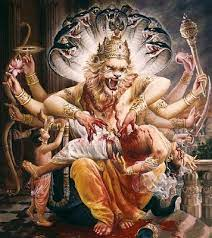
Vishnu very calmly replied that Vishnu was present everywhere even in stones, trees or the pillars of the palace.  HiranyaKasipu in uncontrollable anger, struck the nearest pillar with his sword.  Then to the shocking surprise of HiranyaKasipu, Mahavishnu in the form of a fierce man-lion (Narasimha) jumped out from the pillar and jumped on the body of HiranyaKasipu and tearing him with his nails and brought him to end.

Everything happened in no time and the Narasimha changing into the form of Mahavishnu for the sake of Prahlada, blessed him and disappeared.


(This is a part of Blogchatter's Half Marathon 2023)

Sunday, 27 August 2023

NACIKETAS


          Naciketas (Nachikethas) was a famous hermit boy by his intelligent.  Katopanishad is the exhortation given by Yamadeva the God of Death to this hermit boy.  There is a story to substantiate this statement.

          There was a hermit by name Vajasravas the father of Nachikethas, once performed sacrifices.  At the end of the sacrifices, hermit Vajasravas gave as alms, cows which had grown lean by old-age and lack of food.  Nachiketas felt grieved at this action of his father.  He asked his father, “Father! To whom are you going to give me?”  On hearing this enraged Vajasravas replied his son, “You are to be given to Yama.”

          On hearing these cruel words of his father, the boy Nachikethas went to the palace of Yama who had been away.  For three days and nights the boy waited there without food and drink.

          When Yama returned, the boy Nachikethas was happy and cheerful and Yama was pleased with him.  Yama promised Nachikethas to give three boons and he asked him what boon Nachikethas wanted.

          The clever Nachikethas asked the first boon that “Give me the boon that my father will be pleased and not angry with me.”

          The second was, “Advise me how to attain heaven.”  And the third was “Tell me solution of the mystery, whether the soul remains after the death?”

          On listening to the intellectual Nachikethas, Yama granted the first two boons and said to him, “Dear! Child! Nachikethas! This is a difficult question.”  So ask for another boon such as long life, power over the world, and all the pleasures of the world and so on.

          Then the intelligent Nachikethas replied: “The things you have promised to give me are useless things because after a while the organs of sense will become fragile.  The life also will end.  So please tell me.  I want the answer to my question.”

          Being greatly pleased at the reply of the clever boy Nachikethas, Dharmadeva expounded to him about the immortality of the soul and the essence of things regarding the God Almighty.

(This is a part of Blogchatter's Half Marathon 2023)

SEVEN FASCINATING TOPICS FROM SANSKRIT LITERATURE - 7. THE KATHASARITSAGARA

  THE KATHĀSARITSĀGARA: AN OCEAN OF INTERTWINED STORIES The Kathāsaritsāgara , meaning “The Ocean of the Streams of Stories,” is one of t...