Wednesday, 7 February 2024

SANSKRIT IN HARSHAVARDHANA EMPIRE


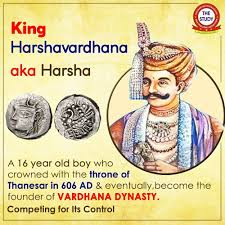
        King Harshavardhana of Sthanesvaram who ruled over the whole of North India from A.D. 606 to 648 is the author of Naganandam.  Apart from being the Emperor of a great kingdom extending from the Himalayas to the Narmada river and from Sourashtra to Brahmaputra, Harshavardhana was himself a poet and a patron of learning.  MahaKavis like BanaBhatta, Kumaradasa and Dharmakirti were some of the famous authors who adorned his court and Bana also wrote his patron’s biography in excellent prose in the work called Harshacaritam.  The Chinese pilgrim Hieun Tsing stayed in Harsha’s court for a long time and became intimate with the emperor.

Harshavardhana or Harsha Deva as he is commonly known in literature has authored three dramas - Priyadarsika, Ratnavali and Naganandam.  The first two plays are modelled after the play Malavikagnimitram of Kalidasa and are based on the legend of Vatsa Raja Udayana and Vasavadatta. 

The best and perhaps the last work was Naganandam written when the author began to have learnings towards the tenets of Buddhism.  The Chinese traveller, Tsing has referred to this work thus - “King Siladitya versified the story of Bodhi Satva Jimutavahana who surrendered himself in place of a Naga.  He had it performed by a band accompanied by dancing and acting and thus popularised it in his time”.

BanaBhatta

Banabhatta was earliest prose writer. He was the writer of Harshacaritam and Kadambari.  He was a court poet of King Harsha. He belongs to the first half of the 7th Century A.D. After his return to his village from pilgrimage, he wrote Harshacaritam partly autobiographical and partly biographical.

Of     the    two     prose     works     of    Bana, Harshacaritam must have been the earlier composition. It has eight chapters. Having given an account of himself Bana traces Harshavardhana’s ancestry to a King called Prabhakaravardhana. He then deals with the life of Prabhakaravardhana and his two sons Rajyavardhana and Harshavardhana and his daughter Rajyashri. The work abruptly ends with Harshavardhana placing his widowed sister under the care of a Buddhist monk and leaving the place to wreak vengeance against the King of Gowdas, the killer of his brother. What made Bana desist from proceeding further from the story is not known.

The other work Kadambari is found to be later production. This abrupt ending may be because of Harsha’s leanings to Buddhism was not tolerated by Bana or the defeat inflicted on his patron by Pulakesin II, was not desired to be recorded. Bana must have referred to this if he had completed the work. This is only a conjecture not supported by any external evidences.

Kadambari is a romance treating the life of two couples namely Kadambari and Chandrapida and Mahasvetha and Pundarika. As a literary work, Kadambari is superior to Harshacharitham. On Kada-mbari in particular, Bana has spent all his wealth of observation and fullness of imagery. Through his work is based on Brhatkatha by Gunadhya, the author has a full scope to display his talent. Bana’s style is referred to as Panchali    style.    He    exhibits    great    skill    in characterisation.  He has used to perfection not only the well-known figures of speech like Upama, Rupakam, Uthpreksha etc., but also difficult ones like Virodhabasa, Akshepa, Vakrokti etc.

Traditional Pundits who have acquired a good grounding in Sanskrit language have appreciated in the following manner - “Baanocchishtam Jagat sarvam, “Kadambari rasajnaanaam Aahaaropi na rochathe”.

Tuesday, 6 February 2024

SANSKRIT IN KASHMIR REGION


The most outstanding contribution of Kashmir to the rich and varied cultural heritage of India has been the development and spread of the Sanskrit language and literature. Almost the entire body of Sanskrit literature has had its origins in Kashmir.

Besides Rajatarangini of Kalhana, the history of Kashmir is enshrined in three other Sanskrit works of Jonaraja, Srivasa, Prajyabhatta and Suka.

Ancient writers in Sanskrit:-

Charaka 300 BC. One of the most important authors in Ayurveda. Charaka, also known as Charaka Muni or Agnivesa, was an ancient Indian physician and scholar who made significant contributions to the field of Ayurveda. Ayurveda is a traditional system of medicine that originated in India more than 5,000 years ago.  He was also known as the court physician during the reign of the famous king Kanishka of Kushan Empire.

Vishnu Sharma the author of Panchatantram was an Indian scholar and author who was lived in the period from 200 BCE to 300 CE. Some scholars place him in the 3rd century BCE. Vishnu Sharman was one of the most widely translated non-religious authors in history. The Panchatantra was translated into Pahlavi in 570 CE by Borz ya and into Arabic in 750 CE by Persian scholar Abdullah Ibn al-Muqaffa as Kal lah wa Dimnah (Arabic: ). In Baghdad, the translation commissioned by Al-Mansur, the second Abbasid Caliph, is claimed to have become "second only to the Qu'ran in popularity".  As early as the eleventh century this work reached Europe, and before 1600 it existed in Greek, Latin, Spanish, Italian, German, English, Old Slavonic, Czech, and perhaps other Slavonic languages. Its range has extended from Java to Iceland.  In France, "at least eleven Panchatantra tales are included in the work of La Fontaine.

Vagbhata the author of Ashtangajrudayam 7th century, considered one of the 'trinity' with   Charaka and Sushruta of Ayurveda.

Jayanta Bhatta, c. 9th century was the author of NyayaManjari, an independent treatise on the Nyaya system together with incidental comments on the Nyayasutra of Gautama.  His another work Nyayakalika contains an enumeruttikara.  He was earliest wroter to adopt the literary style for sastric subjects.

AbhinavaGupta 950-1016 CE was a philosopher, mystic and aesthetician from Kashmir. He was also considered an influential musician, poet, dramatist, exegete, theologian, and logician a polymathic personality who exercised strong influences on Indian culture.

Abhinavagupta was born in a Brahmin family of scholars and mystics who whose ancestors immigrated from Kannauj by the great king of Kashmira, Lalitaditya Muktapida. He studied all the schools of philosophy and art of his time under the guidance of as many as fifteen (or more) teachers and gurus.   In his long life he completed over 35 works, the largest and most famous of which is Tantrāloka, an encyclopedic treatise on all the philosophical and practical aspects of Kaula and Trika (known today as Kashmir Shaivism). Another one of his very important contributions was in the field of philosophy of aesthetics with his famous Abhinavabhāratī commentary of Nāṭyaśāstra of Bharata Muni.

Kshemendra 990-1070 CE was an 11th-century Sanskrit polymath-poet, satirist, philosopher, historian, dramatist, translator and art-critic from Kashmir in India.  Around eighteen of Kshemendra's works are still extant while fourteen more are known only through references in other literature. In addition to the genres listed below, he also composed plays, descriptive poems, a satirical novel, a history, and possibly a commentary on the Kāma Sūtra.

His Abridgements are:-

Ramāyaṇamanjari-Verse abridgement of the Ramayana (Sanskrit)

Bhāratamanjari-Verse abridgement of the Mahabharata (Sanskrit)

Brihatkathāmanjari-Verse abridgement of the Brihatkatha (Sanskrit)

Poetics are:-

Auchitya Vichāra Charchā, Kavikanthābharaṇa, Suvrittatilaka.

Satires are:-

Kalāvilasā - "A Dalliance with Deceptions"

Samaya Mātrikā - "The Courtesan's Keeper" (Sanskrit)

Narmamālā - "A Garland of Mirth"

Deśopadeśa - "Advice from the Countryside"

Didactic works are:-

Nitikalpataru, Darpadalana, Chaturvargasaṃgraha, Chārucharya,

Sevyasevakopadeśa, Lokaprakāśa and Stūpāvadāna.

Devotional works are:-

Avadānakalpalatā - Former lives and good deeds of Buddha (English)

Daśavataracharita - Ten incarnations of Vishnu (Sanskrit)

Historical Work:- Nrpavali

Jalhana 12th century, the author of Mugdhopadesa (not to be confused with Jalhana who commissioned the Suktimuktavali)

Sarangadeva 13th century, a musicologist, wrote Sangita Ratnakara, one of the most important text when it comes to Indian music.


Monday, 5 February 2024

SANSKRIT IN KANISHKA EMPIRE


     Kanishka was regarded as a successor of Vima  Kadphises (Kadphises II) head of the Kushana section of horde took possession of Ki-pin and Kabul and became complete master of the Indian borderland.

          Kanishka was the only Scythian King known to have established an era in A.D.78.   According to Hiuen Tsang, the great empire pver which Kanishka exercised his sway had its capital at Purushapura or Peshawar.  Epigraphic evidence points to the inclusion within his dominions of the wide expanse of territory from Gandhara and Sue Vihar to Oudh and Beneras.

          Kanishka’s chief title to fame rest on his monuments and on the patronage he extended to the religion of Sakya-Muni (Buddha).  The celebrated Chaitya that he constructed at Peshawar exited the wonder and admiration of travellers. 

In Buddhist ecclesiastical history Kanishka’s name is honoured as that of the prince who summoned a great council to examine the Buddhist scriptures and prepare commentaries on them. Among the celebrities who graced his court the most eminent was Asvaghosha, philosopher, poet, and dramatist. 

According to tradition, Asvaghosha was contemporary or preceptor of Kanishka.  He was the son Suvarnakshi and a resident of Saketa.  He had the titles Bhikshu, Acharya, Bhadanta, Mahakavi and Mahavadin.  He proved his worth by making the horse listen to his discourses leaving aside the fodder and hence his name. 

        Asvaghosha wrote two Mahakavyas and a drama, among them,     1. Saundara-Aanandam in 18 cantos describes how Gautama converted into Buddhist order his half-brother Nanda who was reluctant to leave his life, and the another 2. BuddhaCharitam was originally compose in 28 cantos being  rendered into Chinese and Tibetan language which has been later reconstructed into Sanskrit for 13 cantos. 3. SariputraPrakaranam  or SaradvatiputraPrakaranam in nine acts dealing with the conversation of Maudgalyayana and SariPutra into Buddhism.  The canon of dramaturgy are all strictly followed by the author.


Sunday, 4 February 2024

SANSKRIT IN GUPTA EMPIRE


        SamudraGupta, who was nominted successor to the imperial throne of the Guptas, after A.D 320 and died before A.D 380.   He appears to be mentioned in the “Arya manju sri mula kalpa” and also    in the Tantrikamandala, Javanese text.

The Gupta period is known as the “Golden age” owing to its rich contribution to literature and science. The Sanskrit literature under the Gupta period reached extraordinary heights, and the era witnessed the greatest writers and poets of all time. The Gupta period is distinct from the rest of ancient Indian history.

The Sanskrit language, once ignored under the Buddhist and Jain influence, was patronised during the Gupta period. It was recognised as the court language and was used in their inscriptions. Gradually it became the lingua franca of India. Even Buddhist scholars, especially the followers of the Mahayana cult, began writing their scriptures in Sanskrit. The Jain writers too, who had been writing in Pali and Prakrit, switched over to Sanskrit, which gradually became the literary language of northern India.
          The Gupta rulers encouraged higher learning by patronizing centers of higher education at Nalanda, Takshila, Ujjain, Vikramshila and Vallabhi. Each university specialized in a particular field of study. Takshila specialized in the study of medicine, while Ujjain laid emphasis on astronomy. Nalanda, being the biggest centre, handled all branches of knowledge. During the Gupta period India became a centre for higher studies by attracting scholars from all parts of India and from several foreign countries.

          Nalanda University. Nalanda, situated near Rajgriha in Bihar, was probably the highest seat of Buddhist learning. It was established as a Buddhist monastery probably during the reign of Kumara Gupta I (414-445 A.D). A Buddhist tradition says that Sakraditya established this centre of learning. It was spread over an area of 1:6 km x 0.8 km. It had about 1500 professors and 10,000 students. Such eminent people as Panini, Jivaka and Chanakya are said to have studied there. The university had helped to spread Indian culture in foreign countries such as Tibet, China, and Central Asia and also in South East Asian countries.

          Takshila University. This centre of learning was situated about 50 km west of Rawalpindi in Pakistan. It was not a well-organized university like Nalanda. Panini, the famous Sanskrit grammarian, Kautilya who wrote Arthashastra and Charaka, the famous physician of ancient India, and Chandragupta Maurya were the products of this university.

Great poets, dramatists, grammarians and playwrights lived in the period. Some of the well-known scholars who flourished during this period are mentioned below:
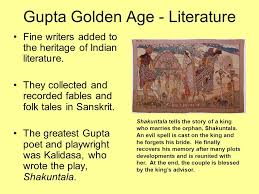
Kalidasa was the greatest Sanskrit poet and playwright of this age. Meghadutam and Rtu Samharam are his lyrical poems, while Kumara Sambhavam and Raghuvamsam are great epic poems. Among his plays, Abhijnana Shakuntalam is known for its fine characters, imagery and choice of words. Among his other plays the most important are Vikramorvasiyam and Malvikagnimitram.

Visakhadatta was a great poet and playwright of the Gupta period. His two great historical plays are Mudra-Rakshasam and Devi Chandra Guptam. Mudra-Rakshasam (seal of Rakshasa) was the story of how Chandragupta Maurya managed to get the throne of Magadha. Devi Chandra Guptam is a historical play dealing with the early life of Chandragupta II.

Sudraka wrote the famous play Mrichchakatikam which throws light on the socio-cultural conditions of the Gupta period.

Harisena was court poet of Samudragupta. He wrote a famous poem praising the valour of Samudraguta. The poem is inscribed on the Allahabad Pillar.

Bharavi wrote the great epic Kiratarjuniyam. In this epic he describes the battle between Arjuna and Lord Shiva disguised as 'Kirata'.

Dandin was a versatile writer. His Dasa Kumara Charitam (Tales of the Ten Princes) describes the adventures of ten princes. These adventures give us information on the socio-cultural conditions of that period.

Subandhu was a prose writer. In his famous Vasavadatta, he narrates the story of the heroine Vasavadatta and prince Kandarpaketu. During the Gupta period the Sanskrit grammar was systematically written by such grammarians as Panini and Patanjali.

During the Gupta period the Panchatantram, a collection of fables, was written by the great scholar VishnuSarma. It is said that these stories were written to teach statecraft to disinterested princes. In these stories, animals and birds play the part of king's ministers and common men. These animal stories were a help in instructing children in moral values. The famous work Hitopadesa of NarayanaKavi is based on Panchatantra. The Panchatantra has been translated into many languages and no other book except the Bible has been translated into so many languages as this famous book. The book is a treasure-house of people's feelings and emotions in human relations. The stories contain wisdom and common sense needed for daily living.

Sanskrit was the Guptas' court language, and while the period produced considerable Brahmanical sacred writing, it also generated a few of the earliest secular works. To conclude, the era witnessed the flourishing of Sanskrit literature under the Gupta period.


Saturday, 3 February 2024

SANSKRIT IN THE MAURYA EMPIRE


In 326 B.C. India was faced with a crisis.  The imperial crown of Magadha and the neighbouring provinces was worn by a king who was “detested and held cheap” by his own people.  Signs of disaffection against foreign rule appeared in the Indian borderland as early as 326 B.C. when the Macedonian king was still in the Punjab.

Retribution came quickly and, if tradition is to be believed, it was a Taxilian Brahmana named Chanakya or Kautilya, who raised to power the great avenger to whose mighty arms “the earth, long harassed by outlanders, now turned for protection and refuge”.

The new Indian leader was a young man who bore the name of ChandraGupta.  The family to which this young leader belonged in named Mauraya.  According to one tradition the designation is derived from the word Mura, the mother of Grandmother of ChandraGupta, who was the wife of a Nanda king. On the other hand, the mediaeval epigraphs represent the Mauryas as Kshatriyas of the solar race.  Buddhist writers of an early date also knew them as members of Kshatriya, probably lying between Rummindei in the Napalese Tarao and Kasai in the Gorakhpur district, in the days of the Buddha.  The cognomen Vrishala applied to ChandraGupta in the Sanskrit play called MudraRakshasam .

The successor of ChandraGupta Maurya was his son BinduSara apparently called AmitraGhata, “Slayer of foes” who reigned from 300 B.C. to 273 B.C.  His reign was probably terminated in 273 B.C, Asoka the great, his successor solemnly enthroned at Pataliputra who was generally called as “Devanam priyaha”(Beloved of the Gods) and “Priyadarsanaha” (of amiable appearance).  He made an open confession of his faith in the Buddha, the Dharma (the Buddhist doctrine) and the Sangha (the Buddhist order of monks).


ArthaSastras attributed to Kautilya, the traditional minister of ChandraGupta was a treatise on polity and a detailed record of administration.  Three works, the Kautilya ArthaSastra, the KalpaSutra of BhadraBahu and the Buddhist Katha Vatthu are traditionally attributed to personages who are said to have flourished in the Maurya period.

The Grammarian knows the Pandu epic and refers to dramatic recitals and the performance of KamsaVadha (slaying of Kamsa by Krshna) and BaliBandha (binding of Bali by Vishnu in His Dwarf Incarnation.)  A main Sanskrit-grammar treatises called MahaBhashyam,  of Patanjali, SarvaVarman’s Katantram, Gunadya’s BruhatKatha, Hala’s GathaSaptaSati were  found compose in this Mauryan Era.  Some schoalrs believe that the astronomical work of Garga, the PaumaChariya of VimalaSuri, portions of the DivyaAvadhana, LalitaVistara and the SaddharmaPundarika are also to be assingned to this Mauryan Era.

Friday, 2 February 2024

SANSKRIT IN MAGADHAN ASCENDANCY


There were powerful Rajas (kings) in South Bihar and Orissa, as well as in Malwa and the Punjab who were fighting to extend their authority to build up true imperial States.  The Raja of Madhyadesa, carried on the affairs of his realm with the assistance of the Sabha (court), usually consisting of the princes of the blood and military chiefs.  For the efficient discharge of his duties he had to learn the Vedas and the Sastras (science subjects).

The most important feature of the administrative development of the period under review was the rise of a class of high officials styled Mahamantras, who are unknown to the Vedic texts and gradually tend to disappear after the Maurya and Satavahana periods.  

The word Kikata occurs once only in the Rg-Veda.III 53.14, and as the word Kikata in later literature meant Magadha or a part of it from Chunar to Rajgir (Visva-Kosa, from Sakti Sangama Tantra).

They were charged with duties of a varied character.  Some looked after Sarvarthakas (general affairs).  Other administered Vyavaaharikas (justice).  A third body had charge of Sena-Nayaka (the army). Others were entrusted with the work of Rajju-Grahaka (cadastral survey) or Drona-Mapaka i.e., measurement of the king’s shares of the produce.  Besides the Raja, there were other functionaries styled Uparaja (Vice-counsul), Senapati (General), Bhandagarika (Treasurer) etc.

About the equipment of Indian troops in the fifth and fourth centuries B.C. we have fortunately a few details recorded by Greek observers.  The Indian infantry, clad in cotton garments, usually carried long bows and iron-tipped arrows made of cane.  Some were armed with spears.  They also carried a two-handed sword and a buckler of undressed ox-hide.  The Chariots, Cavalry and infantry are the main divisions of their army which were generally called in Sanskrit Ratha-Gaja-Turaga-Padati.  The renowned Indian epics he Ramayana and the MahaBharata mentioned the division of the army in Akshauhinis and Vahinis etc.,mention different kinds of battle-array called Vyuhas and allude to various projectiles including the Satagni or hundred-killer.  The great poet and play-write Bhasa of 4th B.C also mentioned about the same Akshauhini in his one-act play DutaVakya, as which is a large division of the army consisting of 21,870 chariots, as many elephants, 65,610 horses and 1,09,350 foot-soldiers.    

Jaina writers refer to the use made by AjataSatru of the MahaSilaKantaga the engine of war of the nature of a catapult which threw big stones and Rathamusala a chariot to which a mace was attached and which, running about, effected great execution.

Thursday, 1 February 2024

SANSKRIT IN VEDIC AGE


Sanskrit is the name of the language that was spoken by the sages of ancient India.  They have expressed their knowledge, wisdom and thoughts in that language.  This language is called SAMSKRTAM means refined because it was regulated by the strict rules of grammar.  So that it was used in that refined form by the learned and highly cultured people from very early times.

Though this language was branded with divine and Brahmin by those who didn’t know about the reality, it is not applicable because Valmiki, Vyasa, Kalidasa were not Brahmins, without whom this language Sanskrit is unimaginable.  This language was been in use in India not only for religious but also for secular purpose even before 700 B.C.


Two main stages are found to mark the growth of this language.  

They are 1. Vedic period and 2. Classical period. 

During the Vedic period it is called Vedic Sanskrit - the language was simple, natural and forcible.  The Vedas and the texts allied to them represented the literature during this period.

Chronological position of some important works 

Vedas=Indian Vedic texts

Itihasa=Epics

 Puranas- MahaKavyas= Major Court Epics with the forms of  Padya-Gadya-Campu(Poetry, Prose and Mixture of Poetry and Prose),

KhandaKavyas=Erotic and Devotional Lyrics

NitiGranthas = Gnomic and Didactic Poetries 

PasuPakshiKathaGranthas=Tales and Fables, 

Rupakas=Plays or Dramas, 

Alankara Sastras=Poetics, 

Sahitya-Sastras=Dramaturgy, 

UpaVedas or Sastras=Allied subjets to Vedic texts and Scientific Literature and their authors and commentators of above all works, accepted by many Sanskrit scholars, generally found in Indian History.

The Indus valley civilization goes back to the third millennium B.C, while the date usually assigned to the Rig-Veda does not go beyond the second millennium B.C.  But some would place the Vedic civilization before that of the Indus valley and shift the date of the Rig-Veda to a period before 3000 B.C.

The earlier portions of the Rgveda were composed about 3000 B.C.     

The art of poetry was in full bloom as is evidenced through Vedic-Sanskrit  by the splendid collection of lyrics known as the Rk-Samhita which consists of hymns in praise of different gods. The number hymns is 1,017.  These are grouped into books termed Ashtakas or mandalas containing eight and ten hymns respectively, which were recited by priests styled Hotas or Reciters.  Their names are Grtsamada, Visvamitra, Vamadeva etc.

  A knowledge of the art of writing has deduced from references to ASHTAKARNI cows, where the epithets ASHTAKARNI is interpreted to mean “having the sign for the number 8 marked on the ear”.  Architecture made some advance in Rig-Vedic India.  The medical art of the age distinguished quite a number of diseases.  But the physician was called Bhishaj means a fiend-slayer as well as a healer of disease. 

Goddesses like Prithivi, Aditi, Ushas and Sarasvati occupy a very subordinate position.  Another important feature of the Vedic religion is the tendency towards monotheism and even monism.  Sacrifices occupy a prominent place in the Vedic ritual.

The Vedas, in their entirely, were available before 600 B.C when Gautama Buddha preached his doctrines opposing certain doctrines recorded in them.

As regards the interpretation of the Vedas, it must be admitted that the line of traditional interpretation is not an unbroken one.  There were many attempts made to interpret the Vedas before Yaska i.e., before 800 B.C.  Yaska wrote his Nirukta on the etymology of the Vedic words.  He has mentioned about seventeen interpreters of the vedas, prior to him.  None of these works are now available.

After Yaska, the Vedas were commented by many Indian scholars.      The Rgveda was commented by Skandasvamin (600 B.C).

SEVEN FASCINATING TOPICS FROM SANSKRIT LITERATURE - 7. THE KATHASARITSAGARA

  THE KATHĀSARITSĀGARA: AN OCEAN OF INTERTWINED STORIES The Kathāsaritsāgara , meaning “The Ocean of the Streams of Stories,” is one of t...