Sunday, 6 February 2022

28 MORAL FABLES FROM SANSKRIT LITERATURE-TALE 6


The greedy jackal

There was a hunter by name Bhairava in a hamlet called Kalyana Kataka.  He was a sinner by his acts.  Once he went to the Vindhya forest for hunting the animals.  When he moved along with a deer which was killed by him, then he watched that a gigantic wild boar.  So that the hunter kept the deer in a place and he killed that wild boar with a shaft. When he killed the boar which angrily cried loudly, afflicted his with its tusk and kicked him by which the hunter also fell like a tree which was cut and he became dead.  A serpent which came accidentally there, that too died by moving between both of them when those were shaking their legs at the time of their last breath.

At this juncture, a jackal by name Dheergharaava which roamed here there in that forest, was happen to watch those dead bodies of deer, hunter, serpent and boar and happily overwhelmed.  Then it thought thus: Alas! Today is good day for me.

“Akruthepi udhyame pumsaam anya janma krutham phalam l

  Subha-Asubham samabhyethi vidhinaa sanniyojitham  ll ”

I am so lucky because without any effort I have the result of my birth. I will get my heavy food easily. 

“Maasam ekam naro yaathi dhvou maasou mruga-sookarou l

  Ahirekam dhinam yaathi adhya bhakshyo dhanur gunah ll ”

The flesh of hunter for one month, the flesh of the deer and boar for two months and the flesh of the serpent for one day. While taking the food one should consume it slowly.  Now I shall eat string of this bow.  So that I can whet the first stage of my hunger by eating this tasteless string which connected in the two ends of the bow.  By telling so, when it started to break or tear the string from that bow, the tightened string became loosen, sprang with heavy force from the bow and stroke the chest. 

Then the greedy jackal Dheergharaava became dead with broken chest.

Moral of the story:-

“Athi-thrushnaa na karthavyaa thrushnaam naiva parithyajeth l

  Athi-thrushnaa-abhipoothasya sikhaa bhavathi masthake ll”

Never one should be extra-ordinarily greedy.  But no one can be away from greediness. If anyone with extra-ordinarily greediness (there will be fire on his head) he will face the disaster like the greedy jackal.

(This story is taken from the titled Mitralabhah the 1st volume of the book Hitopadesa which has four volumes viz., Mitralaabhah, Suhrudbedhah, Vigrahah and Sandhi written by Narayana Pandita who lived in later part of the 14th Century A.D.)


(#WriteAPageADay, today's word count = 428)

This is a part of Blogchatter's write a page a day campaign.

https://www.theblogchatter.com/campaign-registrations/write-a-page-a-day


Saturday, 5 February 2022

28 MORAL FABLES FROM SANSKRIT LITERATURE-TALE 5


The Story of Mischief Monkey

In the middle of a certain city, a certain person who was the son of a trader started to build a temple in the middle of the thick rows of tree.  He once employed many carpenters, architects and masons to build a temple in his garden. Regularly, they would start work in the morning.  One day, persons like architects, carpenters, painters those who were working left their site and gone for their lunch. 

At this juncture, accidentally a group of monkeys which were roamed here and there reached that place. There a certain carpenter has kept a wooden wedge in the middle of the pillar like big wood-piece which is not fully cut.   The monkeys started to play all over the top of a temple, mansions, branches of the trees, tower of the shrine as per their wish. 

One among them of which the death is expected in the very next moment, when playfully has plucked that wooden wedge kept in the middle of that big wood-piece, being crushed with its tail and the lower part of the body, become dead.

Moral of the story:

"Avyaapaareshu vyaapaaram Yo narah karthum Icchathi  l

  Sa Eva nidhanam yaathi Keelothpaatee iva vaanarah ll"

 It is not wise to poke our nose into unknown affairs.

(This story is taken from the titled Mithrabhedah- the 1st  volume of the book PanchaThanthram which has five volumes viz., MitraBedhah, MitraLaabhah, Kaakolookeeyam, Labdhapranaasam and AparikshitaKaarakam written by Vishnu Sarma was an Indian scholar.  The exact period of the composition of the Panchatantra is uncertain, and estimates vary from 1200 BCE to 300 CE.


(#WriteAPageADay, today's word count = 270)

This is a part of Blogchatter's write a page a day campaign.

https://www.theblogchatter.com/campaign-registrations/write-a-page-a-day


Friday, 4 February 2022

28 MORAL FABLES FROM SANSKRIT LITERATURE-TALE 4


The Story of Old Jackal and an Elephant

There was an elephant by name Karpura Tilaka in a forest called Brahamaranya.  On seeing that all the jackals thought that if this elephant can be killed through any idea, then there will be sufficient food for four months will be available with its heavy body.  Among them, it was promised by an old jackal thus: I will kill this elepahant out of my power of device.

Then that cunning old jackal have approached that Karpura Tilaka saluted it by prostrating its feet and told thus: Oh! Sir! Please me with your glorious eyesight.  Then that elephant asked thus:  Who are you?  Where are you coming from?  Then the old jackal replied thus:  “ I am Jambuka.  I have approached you along with all the wild animals because it is not proper to be live in the forest without our leader.  Scripture says that 

"Yah kulaabhijana-aachaaraihi

   Athi suddhaf Prathaapavaan  l

   Dharmajno neethikusalas

   Sas swaami yujyathe bhuvi ll"

“Whoever so pure by his race, kith and kin, behavioural conducts, valorous, pious and who knows the justice he is capable to be a leader in this world”.  Hence, you are identified and selected you to crown as a king for our animal kingdom because you are having the leadership qualities.  So before the lapsing the auspicious time, Oh! Sir! Please come soon. By telling so the old jackal started to move.

Afterwards, the elephant trapped by the greedy of kingship, by following the path of the old jackal, plunged into the great mire.  Then, the elephant asked the jackal thus: Oh! Friend! Jackal! What is to be done now? I will die being trapped into the mire. Please turn and look at me. The old jackal told with smile thus: Oh! Sir! Please get up by holding my tail because you have believed the words of a person like me.  So that you may experience the unavoidable misery.

Then the elephant Karpura Tilaka which was plunged in to the great mire, eaten by the jackals.

The moral of the story:-

"Upaayena hi yath sakyam na thath sakyam paraakramaihi  l

  Srugaalena hatho hasthee gacchathaa panka-varthmanaa  ll"

Whichever is succeeded by the power of device that can’t be by the power.  The gigantic elephant was killed which has followed the miry-way which was shown by a cunning jackal.

(This story is taken from the titled Mitralabhah the 1st volume of the book Hitopadesa which has four volumes viz., Mitralaabhah, Suhrudbedhah, Vigrahah and Sandhi written by Narayana Pandita who lived in later part of the 14th Century A.D.)


(#WriteAPageADay, today's word count = 385)

This is a part of Blogchatter's write a page a day campaign.

https://www.theblogchatter.com/campaign-registrations/write-a-page-a-day


Thursday, 3 February 2022

28 MORAL FABLES FROM SANSKRIT LITERATURE-TALE 3


WISDOM IS A BOON

In a certain village, there lived four youngsters in close friendship.  Three of them were mastered in all branches of Science, but they lacked common sense.  The other one though he was among them, has not highly educated but had just good common sense.  Once upon a time, those four friends discussed among themselves thus: “What use of knowledge, if one does not travel a foreign country and earn gifts by praising or pleasing the kings? So let us travel abroad.” Doing so, travelling some distance, the eldest (among them) said oh! One of we four is not educated, but just has common-sense.  Acceptance by the king is only for education and not for wisdom.  So we shall not share our earning with him.  And therefore let him go home”.  Now the second one said “oh! Man of wisdom, you go home, as you are not educated”.  Then the third said, “No, it is not right to do so, as we have played together since childhood.  So you great men, please come along and we shall divide our earnings”.

          So they let him also accompany them.  Doing so, in the forest through which they travelled on their way, they happened to see the bones of a dead lion.  One of them remarked “let us test our knowledge.  Because, here lies a dead creature.  Let us bring that to life using the knowledge we have gained.  I shall assemble the skeleton.  “Immediately one of them out of curiosity put the skeleton together.  The second provided it with skin, flesh and blood.  The third one was about to infuse breath of life using his knowledge, but was stopped by Subuddhi.  “Oh! Sir please stop.  The lion will kill us.  If you give life, it is going to kill all of us.”  Said the man of wisdom.  But the third said “You fool, you are letting our learning go waste.”  Then he replied -“Well then just wait for a moment while I climb this tree.”  As he did so, the other infused life into the form and all the three were killed by the lion.  The fourth, climbed down from the tree and went home.  Therefore it is said,  wisdom is better than scholarship.”

Moral of the story:

“Varam buddhir na saa vidhyaa Vidhyayaa buddhirutthamaa  l

   Buddhiheenaa vinasyanthi yathaa the simhakaarakaah  ll”

Better to have good sense than learning as such; for good sense is superior to the mere study of letters; those wanting in common sense perish, as did the revivers of the lion.  

(This story is taken from the titled AparikshitaKaarakam the 5th volume of the book PanchaThanthram which has five volumes viz., MitraBedhah, MitraLaabhah, Kaakolookeeyam, Labdhapranaasam and AparikshitaKaarakam written by Vishnu Sarma was an Indian scholar.  The exact period of the composition of the Panchatantra is uncertain, and estimates vary from 1200 BCE to 300 CE.


(#WriteAPageADay, today's word count = 426 )

This is a part of Blogchatter's write a page a day campaign.

https://www.theblogchatter.com/campaign-registrations/write-a-page-a-day

Wednesday, 2 February 2022

28 MORAL FABLES FROM SANSKRIT LITERATURE-TALE 2


                                        A TIGER AND A GREEDY MAN

Long ago, there was an old tiger living in the forest called Maha Aranya.  One day after taking bath, the tiger sat on the bank of a particular pond with a golden bracelet and Dharbha (grass) in its hand. On seeing the people going by that way, it told thus: Oh! The travellers! Please take this golden bracelet.  On hearing and looking at the bracelet, a greedy traveller thought that  his good fortune is inviting him.  But it is to be examined! Because though it is Ambrosia, when is mixed with poison, it leads to death only.

   Then he decided to ask thus: Where is your bracelet? The old tiger showed by stretching its hand.  Then the traveller asked thus: How can I believe you, you kill others?  The old tiger replied thus: Oh! The traveller! Listen. I was so ill-behaved in my young age. I have lost my wife and children because I have killed many animals and human beings.  Now I am bereft my race.  Then, I was advised by a righteous person to do some virtual deeds. 

     Why don’t you believe me? I become aged, lost nails and teeth and took holy bath as advised by that sage?  Though I am ready to give my gold bracelet to someone, I am unable to erase the thought of people that tiger kills and eats the human beings.  

    You are so poor. I will give it to you. You may get it from me after having taken the bath in this pond.  When that greedy man believed its words and started to take bath in that pond, then he got stuck in the mire and unable to get up from it.  

     On seeing him who got stuck in the mire, the aged tiger told thus:  Hey! You have fallen and stuck in the mire.  I will lift you from it.  By telling so, slowly the aged tiger caught him.

   Then that greedy man thought that though I knew that the tiger always kill others but out of greediness I believed the words of this ferocious one. When he was thinking so, he was killed and eaten by the old tiger.

Moral of the story:-     

"Kankanasya thu lobena Magnaf panke sudustare  l

  Vruddha vyaaghrena sampraapthah pathikas sa mrutho yathaa ll"

A greedy traveler in want of the golden bracelet, stuck in the mire and killed by the tiger.  Greediness leads to disaster.


(This story is taken from the titled Mitralabhah the 1st volume of the book Hitopadesa which has four volumes viz., Mitralaabhah, Suhrudbedhah, Vigrahah and Sandhi written by Narayana Pandita who lived in later part of the 14th Century A.D.)


(#WriteAPageADay, today's word count = 447 )

This is a part of Blogchatter's write a page a day campaign.

https://www.theblogchatter.com/campaign-registrations/write-a-page-a-day

Tuesday, 1 February 2022

28 MORAL FABLES FROM SANSKRIT LITERATURE-TALE 1

Blogchatter is organizing a month long campaign-#write a page a day in which I will be presenting a blogpost every day with a moral tale for all the 28 days of this month February.


A hare and a lion

There was a lion by name Durdhaanta(uncontrollable) in the forest called Mandara. He was always killing the animals. Then all the animals joined together and requested thus: “Why are you killing all the animals? We ourselves will give you one animal every day for your prey”. The lion said ‘let it be so’. Then, the lion was eating an animal every day which was sent for him.

Afterwards, once upon a time that was a turn of an old hare. It thought thus: “With the desire to live let me do something to frighten the lion, if I am going to die, what is the use of pleasing the lion? Therefore I shall make delay to go near that lion”. 

By thinking so, the hare reached near the lion. Then the lion which was suffering from hunger asked the hare with anger thus: “What is the reason for your late arrival?”  Then the hare said thus: “I have not committed any fault. I was seen and forcible caught by another lion.  After having promised that lion to come back.  So I have come here to inform you”. 

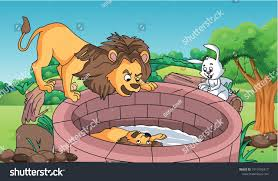
On hearing the words of the hare, the angry lion said thus: “Show that immediately.  Where is that rogue reside?” Then the hare took that lion near a deep well.  “Please come here and see for yourself Master!” Saying so, the hare showed the lion its own reflection in the water of the well. Then the lion being puffed with its pride, jumped into the well out of anger.  With legs upwards and head downwards, the lion got drowned in the water and breathed its last.

The moral of the story:-

“Buddhir yasya balam thasya

Nirbuddhestu kutho balam l

Vane simho madhonmatthah

Sasakena nipaathithahah ll”

“He who possesses intelligence as strength and there is no strength for a person devoid of intelligence.  In the forest the powerful lion which was intoxicated with pride was easily killed by a weak hare”.

         (This story is taken from the titled Suhrudbhedhah the 2nd volume of the book Hitopadesa which has four volumes viz., Mitralaabhah, Suhrudbedhah, Vigrahah and Sandhi written by Narayana Pandita who lived in later part of the 14th Century A.D.)


(#WriteAPageADay, today's word count = 366)

This is a part of Blogchatter's write a page a day campaign.

https://www.theblogchatter.com/campaign-registrations/write-a-page-a-day
Friday, 28 January 2022

WONDERFUL ADVICE OF ATHARVA VEDA TO LEAD PEACEFUL LIFE AND TO HAVE UNITY OF MIND


 “Soumanasya Suktam” or hymn from Atharva Veda is found in the form of Advice.  In this, a certain vedic sage advises people to live in harmony and never to quarrel among themselves.  The sage explains the nature of harmony in this hymn which is one of the many secular hymns.

“Sahrudayam soumanasyam avidvesham krunomi yah l

  Anyo anyam abhiharyata vatsam jaathamivaadhnyaa ll 1 ll”

Oh! People! I make you like-hearted, like-minded, and free from hostility.  You be gratified (show affection), one towards the other, as a cow towards her new born calf.

So, without expecting any return, we shall make others pleased with us.

“Maa bhraathaa bhraatharam dvikshan

  Maa svasaaram utha svasaa l

  Samyanchas savratho bhoothva

  Vaacham vadhathu bhadhrayaa ll 2 ll”

Oh! People! Let not brother hate brother, nor sister hate sister.  Becoming of like courses and of like actions, speak words auspiciously (carefully).

Thus, brothers and sisters should lead a life of good movements, good understanding and doing good-things to one another.  We must have unity of thoughts, words and deeds of course, all being auspiciously.

Let us preserve this unity of mind, speech and actions, through which results immortal happiness.

VĀMANA BHAṬṬA BĀṆA: LIFE AND SANSKRIT WORKS

  Vāmana Bha ṭṭ a Bā ṇ a ( वामनभट्टबाण) was a Sanskrit poet, dramatist, and prose writer associated with the later classical period of Sans...